Today's
EarthStation1.com 15% Off Commemorative Memorial Title: Triumph Of
The West 13 Part TV Documentary Series DVD, Download, USB
Today, November 3, 2025
November 3, 1534: Religion: The History
Of Religion: Abrahamic Religions: Christianity: Protestantism: The
Reformation (The Protestant Reformation, The European
Reformation): Acts Of Supremacy: The First Act Of Supremacy:
Protestantism: The English Reformation: -- The breaking away of
England from the authority of the Pope and the Roman Catholic
Church begins as the Parliament of England passes the First Act Of
Supremacy, granting King Henry VIII Of England and subsequent
monarchs Royal Supremacy, such that he was declared the Supreme
Head of the Church of England. Royal Supremacy is specifically
used to describe the legal sovereignty of the civil laws over the
laws of the Church in England. The act declared that the king was
"the only supreme head on Earth of the Church of England"
and that the Crown shall enjoy "all honours, dignities,
preeminences, jurisdictions, privileges, authorities, immunities,
profits, and commodities to the said dignity." The wording of
the act made clear that Parliament was not granting the king the
title (thereby suggesting that they had the right to withdraw it
later); rather, it was acknowledging an established fact. In the
Act Of Supremacy, Henry abandoned Rome completely. He thereby
asserted the independence of the Ecclesia Anglicana. He appointed
himself and his successors as the supreme rulers of the English
church. Earlier, Henry had been declared "Defender of the
Faith" (Fidei defensor) in 1521 by Pope Leo X for his
pamphlet accusing Martin Luther of heresy. Parliament later
conferred this title upon Henry in 1544. The 1534 Act marks the
beginning of the English Reformation. There were a number of
reasons for this Act, primarily the need for a male heir to the
throne. Henry tried for years to obtain an annulment of his
marriage to Catherine Of Aragon, and had convinced himself that
God was punishing him for marrying his brother's widow. Pope
Clement VII refused to grant the annulment because, according to
Roman Catholic teaching, a validly contracted marriage is
indivisible until death, and thus the pope cannot annul a marriage
simply because of a canonical impediment previously dispensed. The
Treasons Act was later passed: it provided that to disavow the Act
Of Supremacy and to deprive the king of his "dignity, title,
or name" was to be considered treason. The most famous public
figure to resist the Treasons Act was Sir Thomas More. On Sale @
15% Off Discount Till Midnight PT!
https://store.earthstation1.com/triumph-of-the-west-tv-series-5-dual-layer-dvds-all-13-sh513.html
Today's
EarthStation1.com 15% Off Commemorative Memorial Title: Heaven Man
Earth: Kowloon Walled City & Hong Kong Triads MP4 Or DVD
Today, November 3, 2025
November 3, 1839: The Century Of
Humiliation (The Hundred Years Of National Humiliation)
(1838-1945): The Opium Wars: The First Opium War (The Opium War,
The Anglo-Chinese War): -- British frigates blow up several
Chinese junks, marking the beginning of The First Opium War, a
series of military engagements fought between the United Kingdom
and the Qing dynasty over conflicting viewpoints on diplomatic
relations, trade, and the administration of justice in China. In
the 17th and 18th centuries demand for Chinese goods (particularly
silk, porcelain, and especially tea) in Europe created a trade
imbalance between Qing Imperial China and Great Britain. European
silver flowed into China through the Canton System, which confined
incoming foreign trade to the southern port city of Canton. To
counter this imbalance, the British East India Company began to
auction opium grown in India to independent foreign traders in
exchange for silver, and in doing so strengthened its trading
influence in Asia. The opium was transported to the Chinese coast
where local middlemen made massive profits selling the drug inside
China. The influx of narcotics reversed the Chinese trade surplus,
drained the economy of silver, and increased the numbers of opium
addicts inside the country. In 1839 the Daoguang Emperor,
rejecting proposals to legalise and tax opium, appointed viceroy
Lin Zexu to solve the problem by banning the opium trade. Lin
confiscated around 20,000 chests of opium (approximately 1210 tons
or 2.66 million pounds) without offering compensation and ordered
a blockade of foreign trade in Canton. The British government,
although not officially denying China's right to control imports
of the drug, objected to this unexpected seizure and dispatched a
military force to China. In the ensuing conflict the Royal Navy
used its naval and gunnery power to inflict a series of decisive
defeats on the Chinese Empire,a tactic later referred to as
gunboat diplomacy. In 1842 the Qing Dynasty was forced to sign the
Treaty of Nanking, the first of what the Chinese later called the
unequal treaties, which granted an indemnity and
extraterritoriality to Britain, opened five treaty ports to
foreign merchants, and ceded Hong Kong Island to the British
Empire. The failure of the treaty to satisfy British goals of
improved trade and diplomatic relations led to the Second Opium
War (1856-60), and the Qing defeat resulted in social unrest
within China. In China, the war is considered the beginning of
modern Chinese history. On Sale @ 15% Off Discount Till Midnight
PT!
https://store.earthstation1.com/heaven-man-earth-the-organized-crime-of-the-chinese-triads-dvd.html
Today's
EarthStation1.com 15% Off Commemorative Memorial Title: Ulysses S.
Grant & The Battle Of The Wilderness DVD MP4 USB Drive
Today, November 3, 2025
November 3, 1868: Elections: Elections In
The United States: The 1868 United States Presidential Election:
-- Republican nominee Ulysses S. Grant defeats Democratic nominiee
Horatio Seymour. It was the first presidential election to take
place after the conclusion of the American Civil War and the
abolition of slavery, the first election in which African
Americans could vote in the reconstructed Southern states, in
accordance with the First Reconstruction Act, and the first
election of the Reconstruction Era. The 1868 United States
Presidential Election was the 21st quadrennial presidential
election. Incumbent president Andrew Johnson had succeeded to the
presidency in 1865 following the assassination of Abraham Lincoln,
a Republican. Johnson, a War Democrat from Tennessee, had served
as Lincoln's running mate in 1864 on the National Union ticket,
which was designed to attract Republicans and War Democrats. Upon
accession to office, Johnson clashed with the Republican Congress
over Reconstruction policies and was impeached and nearly removed
from office. Johnson received some support for another term at the
1868 Democratic National Convention, but, after several ballots,
the convention nominated Seymour, who had formerly served as
Governor of New York. The 1868 Republican National Convention
unanimously nominated Grant, who had been the highest-ranking
Union general at the end of the Civil War. The Democrats
criticized the Republican Reconstruction policies, and "campaigned
explicitly on an anti-black, pro-white platform," while
Republicans campaigned on Grant's popularity and the Union victory
in the Civil War. Grant decisively won the electoral vote, but his
margin was narrower in the popular vote. In addition to his appeal
in the North, Grant benefited from votes among the newly
enfranchised freedmen in the South, while the temporary political
disfranchisement of many Southern whites helped Republican
margins. As three of the former Confederate states (Texas,
Mississippi, and Virginia) were not yet restored to the Union,
their electors could not vote in the election. This was the last
time that Missouri supported the Republican candidate until 1904.
This was also the last time until 1912 that the Democrats carried
more electoral votes from the North (46) than from the South (34),
though this was partly due to extremely exceptional circumstances
involving the Reconstruction, and in 1912 the reversal occurred
due to the better Democratic performance nationwide as well as the
higher population of the North. This was also the last time the
Republicans did better in the popular vote in the South than in
the North until 1964, again due to very large majorities in
reconstruction states like South Carolina and Tennessee. On Sale @
15% Off Discount Till Midnight PT!
https://store.earthstation1.com/ulysses-s-grant-amp-the-battle-of-the-wilderness-dvd-mp4-usb-driv4.html
Today's
EarthStation1.com 15% Off Commemorative Memorial Title: World War
I: The War Files TV Series DVD, Video Download, USB Drive
Today, November 3, 2025
November 3, 1918: The European Civil War:
World War I: The First European War (The European Theater Of World
War I): The Western Front Of World War I: Naval Warfare Of World
War I: The Naval Order Of 24 October 1918: The Kiel Mutiny: The
Wilhelmshaven Mutiny: The German Revolution Of 1918-1919: -- The
German Revolution Of 1918-1919 begins when 40,000 sailors take
over the port in Kiel during the Kiel Mutiny (German: Kieler
Matrosenaufstand), a major revolt by sailors of the German High
Seas Fleet which triggered the German Revolution, swept aside the
monarchy, ended the German Empire, ended World War I and
established of the Weimar Republic. Led by the sailor Karl Artelt,
who worked in the repair ship yard for Imperial German Navy
torpedo boats in Kiel-Wik, and by the mobilized shipyard worker
Lothar Popp, both USPD (Independent Social Democratic Party of
Germany) members, the sailors called for a mass meeting of
sailors, unions, workers and workers' representatives. The slogan
"Frieden und Brot" (peace and bread) was raised showing
that the sailors and workers demanded not only the release of
their comrades who had been imprisoned in the aftermath of the
Wilhelmshaven Mutiny of October 29-30, which was the original and
most immediate reason for the demonstration,, but also the end of
the war and the improvement of food provisions. Eventually the
people supported Artelt's call to free the prisoners, and they
moved in the direction of the military prison. Sublieutenant
Steinhauser, who had orders to stop the demonstrators, ordered his
patrol to give warning shots and then to shoot directly into the
demonstrators. Seven men were killed and 29 were seriously
injured. Some demonstrators also opened fire. Steinhauser was
severely injured by rifle-butt blows and shots, but contrary to
later statements, he was not killed. After this incident, commonly
viewed as the starting point of the German revolution, the
demonstrators dispersed, and the patrol withdrew. The German
Revolution or November Revolution (German: Novemberrevolution) was
a civil conflict in the German Empire at the end of the First
World War that resulted in the replacement of the German federal
constitutional monarchy with a democratic parliamentary republic
that later became known as the Weimar Republic. The revolutionary
period lasted from November 1918 until the adoption in August 1919
of the Weimar Constitution. The causes of the revolution were the
extreme burdens suffered by the population during the four years
of war, the strong impact of the defeat on the German Empire and
the social tensions between the general population and the elite
of aristocrats and bourgeoisie who held power and had just lost
the war. The first acts of revolution were triggered by the
policies of the German Supreme Command of the Army and its lack of
coordination with the Naval Command. In the face of defeat, the
Naval Command insisted on trying to precipitate a climactic battle
with the British Royal Navy by means of its naval order of October
24, 1918. The battle never took place; instead of obeying their
orders to begin preparations to fight the British, German sailors
led a revolt in the naval ports of Wilhelmshaven on October 29,
1918, followed by the Kiel Mutiny in the first days of November.
These disturbances spread the spirit of civil unrest across
Germany, and ultimately led to the proclamation of a republic on
November 9 1918. Shortly thereafter, Emperor Wilhelm II abdicated
his throne and fled the country. The revolutionaries, inspired by
socialist ideas, did not hand over power to Soviet-style councils
as the Bolsheviks had done in Russia, because the leadership of
the Social Democratic Party of Germany (SPD) opposed their
creation. The SPD opted instead for a national assembly that would
form the basis for a parliamentary system of government. Fearing
an all-out civil war in Germany between militant workers and
reactionary conservatives, the SPD did not plan to strip the old
German upper classes completely of their power and privileges.
Instead, it sought to integrate them into the new social
democratic system. In this endeavour, SPD leftists sought an
alliance with the German Supreme Command. This allowed the army
and the Freikorps (nationalist militias) to quell the communist
Spartacist uprising of 4-15 January 1919 by force. The same
alliance of political forces succeeded in suppressing uprisings of
the left in other parts of Germany, with the result that the
country was completely pacified by late 1919. Elections for the
new Weimar National Assembly were held on 19 January 1919. The
revolution ended on 11 August 1919, when the Weimar Constitution
was adopted. On Sale @ 15% Off Discount Till Midnight PT!
https://store.earthstation1.com/world-war-i-the-war-files-dvd-2-part-documentary-serie2.html
Today's
EarthStation1.com 15% Off Commemorative Memorial Title: Heil
Hitler! Confessions Of A Hitler Youth: Alfons Heck DVD, MP4. USB
Today, November 3, 2025
November 3, 1928: #BOTD: #HBD! Alfons
Heck, Hitler Youth Officer, fanatical adherent of Nazism during
the Third Reich, recipient of the Iron Cross from Adolf Hitler
personally, who as a hostile attendee at the Nuremberg Trials
learned the truth about the Nazis and then resolved to turn his
life around to help prevent what happened to him from happening to
children in other totalitarian societies (d. April 11, 2005) is
#born in the Rhineland, a loosely defined area of Western Germany
along the Rhine, chiefly its middle section. In the 1970s, Heck
began to write candidly of his youthful military experiences in
news articles and two books. Thereafter, he entered into a
partnership with Jewish Holocaust survivor Helen Waterford, each
presenting their differing wartime circumstances before more than
200 audiences, most notably in schools and colleges. Heck was born
in the Rhineland. He was raised by his grandparents at their farm
in the crossroads wine country community of Wittlich, Germany.
When he entered school at the age of 6, he and his classmates were
first exposed to effective Nazi indoctrination by their
virulently-nationalistic teacher. Four years later, Heck and his
classmates joined the five million in the Hitler Youth. Heck was a
good student and found learning easy. He was appointed leader of
about ten other boys. By then, his indoctrination and his devotion
to the proud future of Hitler's Third Reich were nearly complete.
He understood that the first rule of service to a greater Germany
was to follow orders without question, and he was willing to
report "suspicious actions" or comments, even by friends
or family, to his leader. At 14, all Deutsches Jungvolk were
required to join the senior Hitler Youth branch, the Hitlerjugend.
In part to avoid becoming an infantry officer, Heck applied to the
elite Flying Hitler Youth (Flieger Hitlerjugend), although he was
apprehensive about its year-long glider plane training. But within
weeks he became obsessed with flying and landing gliders. His life
course had changed. He would not study to be a priest, as his
grandmother had hoped. Heck devoted himself to the task of
becoming a Luftwaffe fighter pilot. He had been taught to believe
that living under Bolshevik-Jewish slavery was too horrible to
contemplate, leaving German victory as the only alternative.
Capture seemed to him worse than death. He thought that only a
glorious death over the battlefield stood in the way of his
sharing in Germany's inevitable triumph. His final transformation
to fanaticism had begun. He described this extended period of
glider training from late 1942 until early 1944 as the happiest of
his life. At 16, Heck became the youngest scholar to receive a
diploma from Aeronaut's Certificate in Sailplane Flying. Heck
recalls the audience response to Hitler: "We erupted into a
frenzy of nationalistic pride that bordered on hysteria. For
minutes on end, we shouted at the top of our lungs, with tears
streaming down our faces: Sieg Heil, Sieg Heil, Sieg Heil! From
that moment on, I belonged to Adolf Hitler body and soul."
However, the Allied invasion of France in 1944 caused his group of
180 Flying Hitler Youth, of which Heck had become the officer in
charge, to be returned to the Wittlich area to organise the
excavation of large anti-tank barriers on the nearby defensive
Westwall. Battlefield losses raised Heck's Hitler Youth rank to
Bannfuhrer, nominally in charge of 3,000 Hitler Youth workers in
the town and its 50 surrounding villages. One of his antiaircraft
crews shot down a damaged B-17 bomber trying to return to its
base. Later, he gave orders in a combat engagement against
advancing Americans in which participants on both sides were
killed. He was considered by friends and superiors to be ambitious
and ruthless. At one point, he gave orders to have an elderly
Luxembourg priest shot if he dared return to the school that Heck
had commandeered for his workers. The priest did not return. In
another incident, he drew his pistol to shoot a Hitler Youth
deserter but was prevented from doing so by a Wehrmacht sergeant.
Heck admitted at the time, as well as afterwards, that he had
become intoxicated by the power he wielded. As the approaching
Americans consolidated their gains, the 16-year-old Bannfuhrer was
ordered back to his Luftwaffe training base. Once there, with the
suspension of training, flight candidates were being ordered to
the front lines to face the American infantry. However, a
Luftwaffe officer, likely for the purpose of preserving Heck's
life, ordered Heck to organise the retrieval of needed radar
equipment near Wittlich and then to take a four-day leave in his
home town. This enabled Heck to don civilian clothes before
surrendering to the advancing Americans. Unaware of his Hitler
Youth rank, the American soldiers used Heck as a translator until
French military authorities began occupying the area. The French
arrested Heck, who served six months of hard labor before finally
being released. Heck was unable to believe that the atrocities
perpetrated by the Nazi regime had actually taken place. Despite
the difficulty of traveling within occupied Germany, he made his
way to Nuremberg to witness what he could of the trials of former
Nazi officers and officials. He later emigrated to Canada, working
in several British Columbia sawmills. He then moved to the US,
where, living in San Diego, he became a Greyhound long-distance
bus driver. During the 1950s and 1960s, Alfons Heck remained
silent about his wartime activities and his involvement in the
Hitler Youth, but he read hundreds of books about the Third Reich,
tracing the lives of surviving Nazi leaders and maintaining an
interest in West German politics. He came to feel that his
generation of young Germans had been callously betrayed by Nazi
strategists. Of the nine and a half million German war dead, two
million were teenagers, both civilians and Hitler Youth. In 1971,
at the age of 43, he became disabled by heart disease. Without a
productive future and increasingly frustrated by his
contemporaries' failure to speak out, Heck began attending writing
classes so that he might record what it was like to have been a
pawn of Nazi militarism. In 1985, he published A Child of Hitler:
Germany in the Days When God Wore a Swastika (Arizona: Renaissance
House, 1985), an account of his life under Nazism. He continued
with The Burden of Hitler's Legacy (Frederick, Colorado:
Renaissance House, 1988). Heck began touring with Waterford in
1980 to talk about their experiences before, during, and after the
war. The aligned speakers became friends as they visited more than
150 universities over nine years, urging youths to avoid
Hitler-type brainwashing. Colorado publisher Eleanor Ayer, who
published Waterford's autobiography "Commitment to the Dead"
in 1987, wrote Waterford and Heck's intertwined stories in her
1995 book Parallel Journeys. In 1989, Heck appeared in the BBC
Documentary The Fatal Attraction of Adolf Hitler. In 1991, he
featured in HBO's documentary Heil Hitler Confessions Of A Hitler
Youth. The film won an ACE for best documentary. In 1992, Heck was
awarded an Emmy for "outstanding historical programming."
In 1991, an HBO documentary based on his books titled Heil Hitler!
Confessions of a Hitler Youth was released. With Heck's narration
and using archived footage, it attempted to explain how millions
of the German youth of the Third Reich followed Nazi propaganda
and became some of the most extreme Hitler followers. Heck also
provided testimony on parallels between the attraction of Nazism
and Islamism and was featured in the documentary Obsession:
Radical Islam's War Against the West. Heck died of heart failure
at Scripps Mercy Hospital in San Diego at the age of 76. His
burial details are not publicly disclosed. On Sale @ 15% Off
Discount Till Midnight PT!
https://store.earthstation1.com/heil-hitler-confessions-of-a-hitler-youth-dvd-alfons-heck.html
Today's
EarthStation1.com 15% Off Commemorative Memorial Title: Hizzoner
The Mayor Jimmy Walker & Fiorello La Guardia MP4 Download DVD
Today, November 3, 2025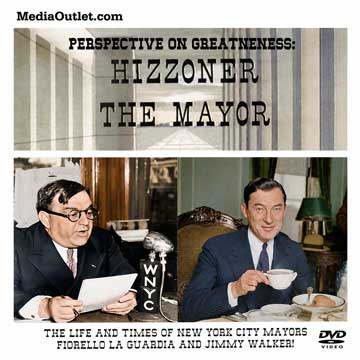
November 3, 1925: Elections: Elections In
The United States: The 1925 New York City Mayoral Election: --
Democratic State Senator Jimmy Walker defeats Republican nominee
Frank D. Waterman and is elected the 97th mayor of New York City.
Incumbent Democratic mayor John Francis Hylan ran for re-election
to a third term in office but was defeated in the Democratic Party
primary Walker. Jimmy Walker, known colloquially as Beau James,
songwriter, record executive and mayor of New York City from 1926
to 1932 (June 19, 1881 - November 18, 1946) was born. A flamboyant
politician, James John Walker was a liberal Democrat and part of
the powerful Tammany Hall machine. He was forced to resign during
a corruption scandal mayor. Walker was the son of Irish-born
William H. Walker, a carpenter and lumberyard owner who was very
active in local politics as a Democratic assemblyman and alderman
from Greenwich Village, belying certain accounts of Walker's
childhood that stated he grew up in poverty. Walker's first
passion seems to be music; in 1905 he stormed Tin Pan Alley
writing songs such as "There's Music In The Rustle Of A
Skirt" and "Will You Love Me in December As You Do in
May?". Walker was not the best of students and dropped out of
college before eventually graduating from New York Law School in
1904. Walker's father wanted him to become a lawyer and
politician. Raised in Greenwich Village among the bohemians,
Walker at first decided that he would rather write songs and be
involved in the music industry, writing many songs, including
"There's Music In The Rustle Of A Skirt" and the 1908
hit "Will You Love Me in December as You Do in May?".
Nevertheless, he eventually entered politics in 1909 and
subsequently passed the bar exam in 1912. Walker was a member of
the New York State Assembly (New York Co., 5th D.) from 1910-1914.
He was a member of the New York State Senate from 1915 to 1925,
and was Minority Leader from 1920 to 1922; Temporary President of
the State Senate from 1923 to 1924; and Minority Leader again in
1925. In the Senate he strongly opposed Prohibition. He also
sponsored the "Walker Law" to legalize boxing in New
York. He was honored a number of times over the years by the
boxing community. Walker is a member of the International Boxing
Hall of Fame and was given the Edward J. Neil Trophy in 1945 for
his service to the sport. After his years in the Senate, Walker
set his sights on the 1925 election for Mayor of New York and ran
against fellow democrat and incumbant John Francis Hylan. Walker's
reputation as a flamboyant man-about-town made him a hero to many
working-class voters; he was often seen at legitimate theaters and
illegitimate speakeasies. Walker was a clothes horse: his valet
packed 43 suits for his trip to Europe in August 1927. On the
other hand, his reputation for tolerating corruption made him
suspect to middle-class and moralistic voters. Governor Alfred E.
Smith was his mentor. Smith was a staunch supporter since Walker
backed many social and cultural issues that were considered
politically important such as social welfare legislation,
legalization of boxing, repeal of blue laws against Sunday
baseball games, condemning the Ku Klux Klan, and especially their
mutual opposition to Prohibition. Smith developed a successful
strategy for Walker to win the election and guided Walker's every
move to overcome his tarnished reputation. Smith used his base in
the strong political machine of Tammany Hall to secure this
victory. Walker had to change some of his more unscrupulous ways
or at least provide a cover for his indiscretions. As with many of
the things in Walker's life, he chose the latter. Instead of
ending his visits to the speakeasies and his friendships with
chorus girls, he took those activities behind the closed doors of
a penthouse funded by Tammany Hall. Walker defeated Hylan in the
Democratic primary, and after defeating Republican mayoral
candidate Frank D. Waterman in the general election, became mayor
of New York City. In his initial years as mayor, Walker saw the
city prosper and many public works projects gain traction. In his
first year, Walker created the Department of Sanitation, unified
New York's public hospitals, improved many parks and playgrounds,
and guided the Board of Transportation to enter into contract for
the construction of an expanded subway system (the Independent
Subway System or IND). Under Walker's administration, new highways
and a dock for superliners were also built. He even managed to
maintain the five-cent subway fare despite a threatened strike by
the workers. However, Walker's term was also known for the
proliferation of speakeasies during Prohibition. It is a noted
aspect of his career as mayor and as a member of the State Senate
that Walker was strongly opposed to Prohibition. As mayor, Walker
led his administration in challenging the Eighteenth Amendment by
replacing the police commissioner with an inexperienced former
state banking commissioner. The new police commissioner
immediately dissolved the Special Service Squad. Since Walker did
not feel that drinking was a crime, he discouraged the police from
enforcing Prohibition law or taking an active role unless it was
to curb excessive violations or would prove to be newsworthy. His
affairs with "chorus girls" were widely known, and he
left his wife, Janet, for showgirl Betty Compton. Walker was
re-elected by an overwhelming margin in 1929, defeating Socialist
Norman Thomas. Walker's fortunes turned downward with the economy
after the stock-market crash of 1929. Patrick Joseph Hayes, the
Cardinal Archbishop of New York, denounced him, implying that the
immorality of the mayor, both personal and political in tolerating
"girlie magazines" and casinos was a cause of the
economic downturn. It was one of the causes that led to Tammany
Hall's pulling its support for Walker. Increasing social unrest
led to investigations into corruption within his administration,
and he was eventually forced to testify before the investigative
committee of Judge Samuel Seabury, the Seabury Commission (also
known as the Hofstadter Committee). Walker caused his own downfall
by accepting large sums of money from businessmen looking for
municipal contracts. One surprise witness in the Seabury
investigation was Vivian Gordon. She informed the investigators
that women were falsely arrested and accused of prostitution by
the New York City Police Department. Police officers were given
more money in their paychecks. After her testimony, Gordon was
suspiciously found strangled to death in a park in the Bronx. That
demonstrated to New Yorkers that corruption could lead to terrible
consequences and that Walker might ultimately, in some way, be
responsible for her death. With New York City appearing as a
symbol of corruption under Mayor Walker, Governor Franklin D.
Roosevelt knew he had to do something about Walker and his
administration. Knowing that the State constitution could allow an
elected mayor to be removed from office, Roosevelt felt compelled
to do so but risked losing Tammany Hall's support for the
Democratic nomination. On the other hand, if Roosevelt did nothing
or let Walker off, the national newspapers would consider him
weak. Facing pressure from Roosevelt, Walker eluded questions
about his personal bank accounts, stating instead that the amounts
he received were "beneficences" and not bribes. He
delayed any personal appearances until after Roosevelt's
nomination was secured. It was then that the embattled mayor could
fight no longer. Months from his national election, Roosevelt
decided that he must remove Walker from office. Walker agreed and
resigned on September 1, 1932. He went on a grand tour of Europe
with Compton, his Ziegfeld girl. He announced on November 12,
1932, while aboard the SS Conte Grande, that he had "no
desire or intention of ever holding public office again."
Walker stayed in Europe until the danger of criminal prosecution
appeared remote. There, he married Compton. After his return to
the United States, Walker acted as head of Majestic Records, which
enjoyed its greatest commercial success in the 1940s until
expansion and supply problems created financial problems, when it
folded in 1948, two years after Walker's death. Majestic Records
featured such popular performing artists as Jimmie Lunceford,
Louis Prima, Bud Freeman, Eddy Howard, the DeMarco Sisters, George
Paxton, Foy Willing and the Riders of the Purple Sage, the Merry
Macs and more. Jimmy Walker died in New York City at the age of 65
of a brain hemorrhage. He was interred in the Gate of Heaven
Cemetery in Hawthorne, New York. A romanticized version of
Walker's tenure as mayor was presented in the 1957 film Beau
James, starring Bob Hope. This was a somewhat accurate depiction
of Walker, who during his time as mayor had become a symbol of the
jazz age romanticism. The film was based on a biography of Walker,
also titled Beau James, written by Gene Fowler. A song by Dean
Martin, similarly titled "Beau James", presented a
highly idealized and romantic interpretation of his tenure as
mayor. A book was also the basis of Jimmy, a stage musical about
Walker that had a brief Broadway run from October 1969 to January
1970. The show starred Frank Gorshin as Walker and Anita Gillette
as Betty Compton. There is also a song about Walker in the stage
musical Fiorello!, "Gentleman Jimmy". Footage of Walker
is used in the 1983 Woody Allen film Zelig, with Walker being one
of the guests during Zelig's visit to William Randolph Hearst's
mansion in San Simeon, California. The 1935 novel It Can't Happen
Here, by Sinclair Lewis, lists the exiles in Paris as "Jimmy
Walker, and a few ex-presidents from South America and Cuba".
Jimmy Walker died in New York City at the age of 65 of a brain
hemorrhage. He is interred in the Gate of Heaven Cemetery in
Hawthorne, New York. On Sale @ 15% Off Discount Till Midnight PT!
https://store.earthstation1.com/perspective-on-greatness-hizzoner-the-mayor-laguardia-walker-nyc-dvd.html
Today's
EarthStation1.com 15% Off Commemorative Memorial Title: Franklin
D. Roosevelt Documentaries DVD, Video Download, USB Drive
Today, November 3, 2025
November 3, 1936: Elections: Elections In
The United States: The 1936 United States Presidential Election:
-- Incumbent Democratic President Franklin D. Roosevelt defeated
Republican governor Alf Landon of Kansas in a landslide victory in
the midst of the Great Depression. Roosevelt won the highest share
of the popular vote (60.8%) and the electoral vote (98.49%,
carrying every state except Maine and Vermont) since the largely
uncontested 1820 election. The sweeping victory consolidated the
New Deal Coalition in control of the Fifth Party System. The 1936
United States Presidential Election was the 38th quadrennial
presidential election. Roosevelt and Vice President John Nance
Garner were renominated without opposition. With the backing of
party leaders, Landon defeated progressive Senator William Borah
at the 1936 Republican National Convention to win his party's
presidential nomination. The populist Union Party nominated
Congressman William Lemke for president. The election took place
as the Great Depression entered its eighth year. Roosevelt was
still working to push the provisions of his New Deal economic
policy through Congress and the courts. However, the New Deal
policies he had already enacted, such as Social Security and
unemployment benefits, had proven to be highly popular with most
Americans. Landon, a political moderate, accepted much of the New
Deal but criticized it for waste and inefficiency. Roosevelt went
on to win the greatest electoral landslide since the rise of
hegemonic control between the Democratic and Republican parties in
the 1850s. Roosevelt took 60.8% of the popular vote, while Landon
won 36.56% and Lemke won 1.96%. Roosevelt carried every state
except Maine and Vermont, which together cast eight electoral
votes. By winning 523 electoral votes and 98.49% of the electoral
vote total, this was the largest share of the Electoral College
since 1820 and the second-largest number of raw electoral votes
ever received by a candidate, and the largest ever for a Democrat.
Roosevelt also won by the widest margin in the popular vote for a
Democrat in history, although Lyndon Johnson would later win a
slightly higher share of the popular vote in 1964, with 61.1%.
Roosevelt's 523 electoral votes marked the first of only three
times in American history when a presidential candidate received
over 500 electoral votes in a presidential election (the others
being in 1972 and 1984) and made Roosevelt the only Democratic
president to accomplish this feat. On Sale @ 15% Off Discount Till
Midnight PT!
https://store.earthstation1.com/franklin-roosevelt-documentaries-dual-layer-dvd.html
Today's
EarthStation1.com 15% Off Commemorative Memorial Title: Harry S.
Truman: Days Of Decision + Bonus DVD, MP4 Download, USB Drive
Today, November 3, 2025
November 3, 1948: Elections: Elections In
The United States: The 1908 United States Presidential Election:
Dewey Defeats Truman: -- The Chicago Daily Tribune (later Chicago
Tribune) newspaper prints an incorrect banner headline on the
front page of its November 3, 1948 edition, published the day
after incumbent United States president Harry S. Truman's November
2, 1948 upset victory over Republican challenger and New York
governor Thomas E. Dewey, in the 1948 U.S. Presidential Election.
On November 4, it was famously held up by a jubilant Truman at a
public appearance during a stop at St. Louis Union Station while
returning to Washington by train from his home in Independence,
Missouri following his successful election, smiling triumphantly
at the error. He stepped to the rear platform of his train car,
the Ferdinand Magellan, and was handed a copy of the Tribune early
edition. Happy to exult in the paper's error, he held it up for
the photographers gathered at the station, and the famous picture
(in several versions) was taken by multiple photographers. Truman
reportedly smiled and said, "That ain't the way I heard it!"
The paper relied on its veteran Washington correspondent and
political analyst, Arthur Sears Henning, who had predicted the
winner in four out of the last five presidential contests since
1928. As conventional wisdom, supported by various public opinion
polls, was almost unanimous that Dewey would win the election by a
landslide, the first (one-star) edition of the Tribune therefore
went to press with the banner headline "DEWEY DEFEATS
TRUMAN". Tribune publishers could laugh about the blunder
years later and had planned to give Truman a plaque with a replica
of the erroneous banner headline on the 25th anniversary of the
1948 election. However, Truman died on December 26, 1972, before
the gift could be bestowed. Henning's obituary in 1966, published
in the Tribune, makes no mention of the event. The Tribune was not
the only paper to make the mistake. The Journal of Commerce had
eight articles in its edition of November 3 about what could be
expected of President Dewey. The paper's five-column headline
read, "Dewey Victory Seen as Mandate to Open New Era of
Government-Business Harmony, Public Confidence". The Tribune,
which had once referred to Democratic candidate Truman as a
"nincompoop", was a famously Republican-leaning paper.
In a retrospective article some 60 years later about the
newspaper's most famous and embarrassing headline, the Tribune
wrote that Truman "had as low an opinion of the Tribune as it
did of him". For about a year prior to the 1948 election, the
printers who operated the linotype machines at the Chicago Tribune
and other Chicago papers had been on strike, in protest of the
Taft-Hartley Act. Around the same time, the Tribune had switched
to a method by which copy for the paper was composed on
typewriters, photographed, and then engraved onto the printing
plates. This process required the paper to go to press several
hours earlier than usual. On Sale @ 15% Off Discount Till Midnight
PT!
https://store.earthstation1.com/harry-s-truman-days-of-decision-dvd.html
Today's
EarthStation1.com 15% Off Commemorative Memorial Title: The Race
For Space 1961 Historic Soviet Space Films DVD, Download, USB
Today, November 3, 2025
November 3, 1957: Rocket Launches: The
History Of Rocketry: The History Of Spaceflight: The Aftermath Of
World War II: The Cold War: Animals In Space: -- #DOTD: #RIP:
Soviet Russia launches the world's first inhabited space capsule,
Sputnik II, which carried a dog named Laika. Sputnik 2 (Russian:
"Satellite 2"), or Prosteyshiy Sputnik 2 (Russian:
"Elementary Satellite 2") was the second spacecraft
launched into Earth orbit. Laika survived for several orbits but
died a few hours after the launch. Launched by the U.S.S.R.,
Sputnik 2 was a 4-meter (13 foot) high cone-shaped capsule with a
base diameter of 2 meters (6.6 feet) that weighed around 500 kg,
though it was not designed to separate from the rocket core that
brought it to orbit, bringing the total mass in orbit to 7.79
tonnes. It contained several compartments for radio transmitters,
a telemetry system, a programming unit, a regeneration and
temperature-control system for the cabin, and scientific
instruments. A separate sealed cabin contained the dog Laika. A
100 line television camera provided images of Laika inside the
capsule. Sputnik 2 was launched into space only 32 days after its
predecessor Sputnik 1. Due to the huge success of Sputnik 1,
Nikita Khrushchev ordered Sergey Korolev back to work creating a
Sputnik 2 that needed to be ready for space for the 40th
anniversary of the Bolshevik revolution. The plan for Sputnik 1
and Sputnik 2 was initiated and presented by Korolev, and was
approved in January 1957. At that time, it was not clear that the
Soviets' main satellite plan (which would eventually become
Sputnik 3) would be able to get to space because of the ongoing
issues with the R-7 ICBM, which would be needed to launch a
satellite of that size. "Korolev proposed substituting two
'simple satellites' for the IGY satellite". The choice to
launch these two instead of waiting for the more advanced Sputnik
3 to be finished was largely motivated by the desire to launch a
satellite to orbit before the US. On Sale @ 15% Off Discount Till
Midnight PT!
https://store.earthstation1.com/the-race-for-space-dvd-1961-secret-soviet-f1961.html
Today's
EarthStation1.com 15% Off Commemorative Memorial Title: Fall Of
The Great Society & The Silent Majority: LBJ & Nixon MP4
DVD
Today, November 3, 2025
November 3, 1969: The Aftermath Of World
War II: The Cold War: The Cold War In Asia: The Indochina Wars:
The Vietnam War (The Second Indochina War, The Vietnam Conflict,
The Resistance War Against America): The United States In The
Vietnam War: Addresses To The Nation: Oval Office Addresses: The
Oval Office Addresses Of Richard Nixon: The Silent Majority
Speech: -- U.S. President Richard M. Nixon addresses the nation on
television and radio, asking the "silent majority" to
join him in solidarity on the Vietnam War effort and to support
his policies. The silent majority is an unspecified large group of
people in a country or group who do not express their opinions
publicly.This term was popularized by President Nixon during this
address. It referred to those Americans who did not join in the
large demonstrations against the Vietnam War at the time, who did
not join in the counterculture, and who did not participate in
public discourse. Nixon along with many others saw this group of
Middle Americans as being overshadowed in the media by the more
vocal minority. Preceding Nixon by half a century, it was employed
in 1919 by Warren G. Harding's campaign for the 1920 presidential
nomination. Before that, the phrase was used in the 19th century
as a euphemism referring to all the people who have died, and
others have used it before and after Nixon to refer to groups of
voters in various nations of the world. On Sale @ 15% Off Discount
Till Midnight PT!
https://store.earthstation1.com/fall-of-the-great-society-amp-the-silent-majority-lbj-amp-nixon-mp4-dv4.html
Today's
EarthStation1.com 15% Off Commemorative Memorial Title: Portraits
Of American Presidents Nos. 1-42 TV Series MP4 Download DVD
Today, November 3, 2025
November 3, 1992: Elections: Elections In
The United States: The 1992 United States Presidential Election:
-- Democratic governor Bill Clinton of Arkansas defeated incumbent
Republican president George H. W. Bush and independent businessman
Ross Perot of Texas. The election marked the end of a period of
Republican dominance in American presidential politics that began
in 1968 (with 1976 being the sole exception), and also marked the
end of 12 years of Republican rule of the White House, as well as
the end of the Greatest Generation's 32-year American rule and the
beginning of the baby boomers' 28-year dominance until 2020. It
was the last time the incumbent president failed to win a second
term until Donald Trump in 2020, as well as the first election
since 1932 in which an elected incumbent Republican president was
defeated. Perot won 18.9% of the popular vote, the highest share
of the vote won by a candidate outside of the two major parties
since 1912. Although he failed to win any electoral votes, he
finished second in two states (behind Bush in Utah and behind
Clinton in Maine) and found significant support in every state,
resulting in no state giving an absolute majority to any candidate
except Clinton's home state of Arkansas. As such, this is the
final election to date in which the Democratic nominee won less
than 50% of the vote in California, Connecticut, Delaware, Hawaii,
Illinois, Maryland, Massachusetts, New Jersey, New York, Rhode
Island, and Vermont; and in which the Republican nominee won less
than 50% in Alabama, Alaska, Idaho, Kansas, and Nebraska. It is
also the third and final election since the Civil War in which a
Republican or Democratic nominee failed to break 50% in a single
state (with the exception of Arkansas), the first two being 1912
for William Howard Taft and 1984 for Walter Mondale. As of 2024,
this is the last time that either a Democratic or Republican
candidate received less than 40% of the popular vote. The 1992
United States Presidential Election was the 52nd quadrennial
presidential election, held on Tuesday, November 3, 1992. Bush had
alienated many conservatives in his party by breaking his 1988
campaign pledge not to raise taxes, but he fended off a primary
challenge from paleoconservative commentator Pat Buchanan without
losing a single contest. Bush's popularity following his success
in the Gulf War dissuaded high-profile Democratic candidates such
as Mario Cuomo from entering the 1992 Democratic primaries.
Clinton, a leader of the centrist Democratic Leadership Council,
established himself as the front-runner for the Democratic
nomination by sweeping the Super Tuesday primaries. He defeated
former governor of California Jerry Brown, former Massachusetts
senator Paul Tsongas, and other candidates to win the nomination,
and chose Tennessee senator Al Gore as his running mate.
Billionaire Ross Perot launched an independent campaign,
emphasizing his opposition to the North American Free Trade
Agreement and his plan to reduce the national debt. The economy
had recovered from a recession in the spring of 1991, followed by
19 consecutive months of growth, but perceptions of the economy's
slow growth harmed Bush, for he had inherited a substantial
economic boom from his predecessor Ronald Reagan. Bush's greatest
strength, foreign policy, was regarded as much less important
following the dissolution of the Soviet Union and the end of the
Cold War, as well as the relatively peaceful climate in the Middle
East after the Gulf War. Perot led in several polls taken in June
1992, but severely damaged his candidacy by temporarily dropping
out of the race in July. The Bush campaign criticized Clinton's
character and emphasized Bush's foreign policy successes, while
Clinton focused on the economy. Clinton won a plurality in the
popular vote and a majority of the electoral vote, breaking a
streak of three consecutive Republican victories. He won states in
every region of the country; he swept the Northeast and the West
Coast, marking the start of Democratic dominance in both regions
in both presidential and statewide elections. Clinton also
performed well in the eastern Midwest, the Mountain West,
Appalachia, and parts of the South. This election was the first
time a Democrat had won the presidency without Texas since its
statehood and North Carolina since 1844. This was also the last
time to date that the state of Montana voted Democratic in a
presidential election, and the last time until 2020 that Georgia
did so. This was also the last time Colorado voted Democratic
until 2008. Clinton flipped a total of 22 states that had voted
Republican in the election of 1988. Clinton would win with the
smallest vote share of the national vote since Woodrow Wilson in
1912, when the Republican Party experienced a drastic split. On
Sale @ 15% Off Discount Till Midnight PT!
https://store.earthstation1.com/portraits-of-american-presidents-nos-142-tv-series-mp4-download1424.html
Today's
EarthStation1.com 15% Off Commemorative Memorial Title:
Presidential Campaign TV Ads 1952-1992 MP4 Video Download 4 DVD
Set
Today, November 3, 2025
November 3, 2020: Elections: Elections In
The United States: The 2020 United States Presidential Election:
-- The Democratic ticket of former vice president Joe Biden and
the junior U.S. senator from California Kamala Harris defeats
incumbent Republican president Donald Trump and vice president
Mike Pence. The election took place against the backdrop of the
global COVID-19 pandemic and related recession. The election saw
the highest voter turnout by percentage since 1900. Biden received
more than 81 million votes, the most votes ever cast for a
candidate in a U.S. presidential election. The 2020 United States
Presidential Election was the 59th quadrennial presidential
election. In a competitive primary that featured the most
candidates for any political party in the modern era of American
politics, Biden secured the Democratic presidential nomination.
Biden's running mate, Harris, became the first African-American,
first Asian-American, and third female vice presidential nominee
on a major party ticket. Trump secured re-nomination, getting a
total of 2,549 delegates, one of the most in presidential primary
history, in the Republican primaries. Jo Jorgensen secured the
Libertarian presidential nomination with Spike Cohen as her
running mate, and Howie Hawkins secured the Green presidential
nomination with Angela Nicole Walker as his running mate. The
central issues of the election included the public health and
economic impacts of the ongoing COVID-19 pandemic; civil unrest in
reaction to the police murder of George Floyd and others; the
Supreme Court following the death of Ruth Bader Ginsburg and
confirmation of Amy Coney Barrett; and the future of the
Affordable Care Act. Due to the ongoing pandemic, a record number
of ballots were cast early and by mail. Thirty-eight states had
over half of all votes cast using these methods, and only three
states had fewer than 25%. Many more registered Democrats voted by
mail than registered Republicans. As a result of a large number of
mail-in ballots, some swing states saw delays in vote counting and
reporting; this led to major news outlets delaying their
projection of Biden and Harris as the president-elect and vice
president-elect until the morning of November 7. Major media
networks project a state for a candidate once there is high
statistical confidence that the outstanding vote would be unlikely
to prevent the projected winner from ultimately winning that
state. Biden received the majority in the Electoral College with
306 electoral votes, while Trump received 232. Trump was the first
president to lose re-election since George H. W. Bush in 1992. Key
to Biden's victory were his wins in the Democratic-leaning Rust
Belt states of Michigan, Pennsylvania, and Wisconsin, which Trump
narrowly carried in 2016 and whose combined 46 electoral votes
were enough to swing the election to either candidate. Biden also
became the first Democrat to win a presidential election in
Georgia since 1992 and in Arizona since 1996, as well as
Nebraska's 2nd congressional district since 2008. Before, during,
and after Election Day, Trump and numerous other Republicans
engaged in an aggressive and unprecedented attempt to subvert the
election and overturn the results, falsely alleging widespread
voter fraud and trying to influence the vote-counting process in
swing states in what has been described as an attempted self-coup
d'etat. Attorney General William Barr and officials in each of the
50 states found no evidence of widespread fraud or irregularities
in the election. Federal agencies overseeing election security
said it was the most secure in American history. The Trump
campaign and its allies, including Republican members of Congress,
continued to engage in numerous attempts to overturn the results
of the election by filing numerous lawsuits in several states
(most of which were withdrawn or dismissed), spreading conspiracy
theories alleging fraud, pressuring Republican state election
officials (including, notably, Georgia Secretary of State Brad
Raffensperger, in a phone call that later became widely
publicized) and legislators to change results, pressuring the
Department of Justice to declare the election "corrupt"
and intervene, objecting to the Electoral College certification in
Congress, and refusing to cooperate with the presidential
transition of Biden. With Trump vowing that he would never concede
the election and after exhorting his followers to "fight like
hell", a mob of Trump supporters attacked the United States
Capitol on January 6, 2021, during the joint session of Congress
held to certify the Electoral College count. On January 7, Trump
acknowledged the incoming administration without mentioning
Biden's name. Biden and Harris were inaugurated on January 20,
2021; in a break from tradition, Trump did not attend his
successor's inauguration. Trump was indicted on August 1, 2023, on
four counts relating to conspiring to overturn the results. On
Sale @ 15% Off Discount Till Midnight PT!
https://store.earthstation1.com/presidential-campaign-tv-ads-19521984-dvds-2-dual-la195219842.html
Today's
EarthStation1.com #OnThisDay Commemorative Memorial Title: Jack
Benny Complete Radio Broadcasts Set MP3 DVD, Audio Download, USB
Today, November 3, 2025 November 3: National Sandwich Day: --
Whether you stack it high or thin, National Sandwich Day
recognizes one of America's favorite lunch items! The sandwich is
believed to be the namesake of John Montagu, 4th Earl of Sandwich
(November 13, 1718 - April 30, 1792), following the claim that he
was the inventor of the sandwich. No matter who invented it, we
celebrate every kind of sandwich. While the modern sandwich is
believed to be named after John Montagu, the exact circumstances
of its invention and original use are the subject of debate. There
is a rumor in a contemporary travel book titled Tour to London, by
Pierre Jean Grosley, that formed the popular myth that bread and
meat sustained Lord Sandwich at the gambling table. It is said
that Lord Sandwich was a very conversant gambler and did not take
the time to have a meal during his long hours playing at the card
table. When hungry, he would ask his servants to bring him slices
of meat between two slices of bread. This practice was a habit
that was well known to his gambling friends who soon began to
order "the same as Sandwich," and from this, the
sandwich was born. N.A.M. Rodger, who wrote Sandwich's biography,
suggests that because of Sandwich's commitment to the navy,
politics, and the arts, the first sandwich was more likely to have
been consumed at his work desk. Before being known as sandwiches,
the food seems just to have been called bread and meat or bread
and cheese. In the United States alone, we have some pretty
delicious sandwich inventions. The cheesesteak and sloppy joe are
American classics. Don't forget the muffuletta or the Monte
Cristo. We love our Po boys and grilled cheese, pork tenderloins,
and po'boys, too. However, we can't forget some of these other
absolutely delicious options: BLT, Club, Dagwood, French Dip,
Peanut Butter and Jelly, and Pilgrim, to name just some! To
observe National Sandwich Day, Go out for a sandwich with a friend
or enjoy one of the many different sandwich recipes - and use
#NationalSandwichDay to post on social media.
https://store.earthstation1.com/jack-benny-complete-radio-broadcasts-dual-layer-mp3-dv3.html
November 3: National Sandwich Day: --
Whether you stack it high or thin, National Sandwich Day
recognizes one of America's favorite lunch items! The sandwich is
believed to be the namesake of John Montagu, 4th Earl of Sandwich
(November 13, 1718 - April 30, 1792), following the claim that he
was the inventor of the sandwich. No matter who invented it, we
celebrate every kind of sandwich. While the modern sandwich is
believed to be named after John Montagu, the exact circumstances
of its invention and original use are the subject of debate. There
is a rumor in a contemporary travel book titled Tour to London, by
Pierre Jean Grosley, that formed the popular myth that bread and
meat sustained Lord Sandwich at the gambling table. It is said
that Lord Sandwich was a very conversant gambler and did not take
the time to have a meal during his long hours playing at the card
table. When hungry, he would ask his servants to bring him slices
of meat between two slices of bread. This practice was a habit
that was well known to his gambling friends who soon began to
order "the same as Sandwich," and from this, the
sandwich was born. N.A.M. Rodger, who wrote Sandwich's biography,
suggests that because of Sandwich's commitment to the navy,
politics, and the arts, the first sandwich was more likely to have
been consumed at his work desk. Before being known as sandwiches,
the food seems just to have been called bread and meat or bread
and cheese. In the United States alone, we have some pretty
delicious sandwich inventions. The cheesesteak and sloppy joe are
American classics. Don't forget the muffuletta or the Monte
Cristo. We love our Po boys and grilled cheese, pork tenderloins,
and po'boys, too. However, we can't forget some of these other
absolutely delicious options: BLT, Club, Dagwood, French Dip,
Peanut Butter and Jelly, and Pilgrim, to name just some! To
observe National Sandwich Day, Go out for a sandwich with a friend
or enjoy one of the many different sandwich recipes - and use
#NationalSandwichDay to post on social media.
https://store.earthstation1.com/jack-benny-complete-radio-broadcasts-dual-layer-mp3-dv3.html
Today's
EarthStation1.com #OnThisDay Commemorative Memorial Title: Classic
Family Values Films 1934-1957 DVD, Video Download, USB Drive
Today, November 3, 2025November 3: National Housewife's Day: --
An annual recognition of the millions of hardworking housewives
that make all our lives better due to their diligence,
self-sacrifice, intelligence, caring and love! The day honors the
stay-at-home moms who take care of the children and the home. It's
a 24/7 job that sometimes does not get the "thank you"
that it so richly deserves! The term housewife is an old term
stemming from the days when most families were supported by one
income. The father worked, and the mother stayed home to take care
of the house and the children. These days, usually both parents
work outside the home. According to the Bureau of Labor and
Statistics, in 61 % of households with children, both parents work
outside the home. The age of the children impacts how much a
parent stays home. And it isn't always the mother who stays home.
Sometimes it's the dad. So, househusbands are on the rise. Cheers
to you, too! However, current statistics are difficult to find.
Even so, those who stay home and manage a household have a
difficult task. Those who stay home are considered to be domestic
engineers, managing budgets, children, and organizing the life of
the house. To observe National Housewife Day, honor the housewife
in your family or a housewife that you know - and make sure to use
#NationalHousewifesDay to post on about it on social media!
https://store.earthstation1.com/classic-family-values-films-193419341957.html
Today's
EarthStation1.com #OnThisDay Commemorative Memorial Title: The
Future That Never Happened Plus Future Wars Doc MP4 Download DVD
Today, November 3, 2025November 3: National Homemaker Day: --
Today we celebrate the people who keep our households running!
This day is devoted to appreciating all labor done in homes
including cooking, buying groceries, and carrying out much-needed
repairs. Whoever the homemaker is in your modern family, this is
the chance to thank and celebrate the ones working hard behind the
scenes! In the United States, the person in charge of taking care
of the home while their partner works is called a homemaker. In
our current society, this terms applies to a house-spouse of any
gender who works hard to keep their home in order. A homemaker can
also be an adult's parent or family member helping take care of
the home and any present children. However, in the past, a
homemaker would normally be the wife or matriarch of a family
unit. In the 19th century, women were required to stay back and
maintain the home as a peaceful environment for their husbands and
children. Though the 20th century began with many of the same
homemaking ideals as the 19th, by the 1990s more marriages
consisted of both men and women participating in housework.
Unfortunately, according to a study performed by Adam Hochschild
in 1989, women who made more than 50% of income were still doing
the majority of the housework. Being a homemaker in the 21st
century is not a lifetime commitment like it was in the 1800s.
Someone who might stay at home now may want to return to the
workforce later, while their partner will either continue working
as well or decide to switch places and takeover the housework
duties. Currently, more men are contributing to housework and are
even the main homemakers, opting to stay at home while their wives
or husbands are the primary breadwinners. Though the number of
female house-spouses still outweigh their male counterparts, the
gap between the two is steadily closing as people abandon
traditional gender norms for approaches that fit their individual
lifestyles.
https://store.earthstation1.com/the-future-that-never-happened-predictions-of-our-today-dvd-mp4-us4.html
Today's
EarthStation1.com #OnThisDay Commemorative Memorial Title: Yours
Truly Johnny Dollar Radio Series MP3 DVD, Download, USB Drive
Today, November 3, 2025November 3: Give Someone A Dollar Day: --
Today's a good day to give a dollar to someone! Despite the fact
that a dollar isn't worth what it used to be these days, there are
still some things that a dollar can buy. On this day, you can give
a dollar to someone you know or someone you've never met. You can
also give a dollar to anyone who appears to be in need or deserves
it. The origins of this holiday are unknown, however, because it
is not an official holiday, schools, banks, and government
buildings will be open. People are unlikely to get the day off,
but they can use the time they do have to celebrate the holiday in
the spirit of giving. Given how little is known about Give Someone
A Dollar Day, let's learn a little more about the symbol of the
day: the United States dollar. The one-dollar bill, also known as
a single, has been the lowest value denomination of the United
States' paper currency since the termination of fractional
currency notes in 1876. The front face has a portrait of George
Washington, the first president of the United States, taken from
the 'Athenaeum Portrait,' a Gilbert Stuart painting. The reverse
features the United States Great Seal. The one-dollar bill boasts
the oldest general design of any current U.S. currency in
production. The typical lifespan of a $1 bill in circulation is
6.6 years before it needs replacement due to wear. One-dollar
bills accounted for almost 42% of all U.S. printed currency in
2009. There were 12.7 billion one-dollar bills in circulation
worldwide as of December 31, 2019. Give Someone A Dollar Day is a
reminder of the value of the dollar bill and the symbolic act of
giving to others. It is a time to act on one of the most basic and
often disregarded aspects of human nature - kindness. You may not
give much to the person to whom you are giving the dollar; they
may not even need it, but it is the act of kindness that counts.
You can rally your friends and family to join you in your giving
spree, or you can start a donation pot and donate the proceeds to
a charity.
https://store.earthstation1.com/yours-truly-johnny-dollar-old-time-radio-dual-layer-mp3-dv3.html
Today's
EarthStation1.com #OnThisDay Commemorative Memorial Title: HRH The
Prince Of Wales: The Earth In Balance DVD, Download, USB Drive
Today, November 3, 2025November 3: One Health Day: -- Addressing
global health issues requires collaboration, innovative solutions,
and sustainable practices to improve well-being worldwide. When
people work together for the good of every plant, animal and human
on the planet, there's a lot of good that can be accomplished for
the benefit of all! One Health Day is part of a larger
collaborative effort to build networks of people and organizations
that will join together in making the world a healthier place for
everyone. One Health Day was founded in 2016 through the efforts
of the folks at the One Health Commission along with their various
partners. The One Health Commission is a non-profit organization
that was started in the United States in 2009, bringing together
different stakeholders in the local, regional, national and
international levels who are working in various sectors, including
health for people, animals, plants and the environment they all
share. Targeted toward professionals in a wide range of
disciplines, One Health Day encourages the sharing of information
and support to help overcome health challenges on a planetary
level. This day brings worldwide attention to the collaborative
efforts that have been going on through One Health, bringing
inclusion for current efforts and inspiration for projects to
come. By the end of 2023, there were more than 950 One Health Day
events that were registered since the launch of the event - and
many more that weren't registered but took place in celebration of
the day.
https://store.earthstation1.com/hrh-the-prince-of-wales-the-earth-in-balance-dvd.html
Today's
EarthStation1.com #OnThisDay Commemorative Memorial Title: Japan:
A Cherry Blossom By Many Other Names MP4 Video Download DVD
Today, November 3, 2025November 3: Culture Day Japan: -- The
constitution of Japan established this day as a national holiday.
This day is also known as 'Bunka no Hi' and mostly celebrates the
culture, academia, and arts of Japan. This national event is
celebrated to pay respects to the traditional Japanese culture and
to promote the notion of peace and freedom that is declared in the
constitution of Japan. This public holiday was officially
announced after the Second World War. In the first week of
November, Education and Culture Week is observed. Events related
to education and culture are held this week, which create a deep
interest for people in Japanese culture. Culture Day Japan has
been a public holiday since 1948 and was established two years
after the Constitution of Japan was officially announced in 1946.
November 3 is an important date because it was the birthdate of
the late Emperor Meiji. Emperor Meiji ruled Japan from 1867 to
1912. In 1927, this day was declared a national holiday known as
Meiji Setsu to give respect to the late Emperor. This was later
changed to Culture Day. The celebrations for Culture Day are not
limited to November 3 and they carry on for some days. The various
festivities held across the different places in Japan encourage
the people to engage in their culture and the museums in the
country are free to visit on Culture Day so that people can learn
more about their culture and country. Many prestigious awards
ceremonies are arranged on this day, which acknowledge the
contributions of individuals promoting the Japanese culture.
Moreover, this day is important for universities and students.
Schools display the artwork of their students to show off their
talent. Many other events are held on this day, including parades
and festivals. These parades showcase the traditions and clothing
of the Japanese culture and are organized by the government across
the country.
https://store.earthstation1.com/japan-a-cherry-blossom-by-many-other-names-mp4-video-download-dvd.html
Today's
EarthStation1.com #OnThisDay Commemorative Memorial Title: The
Indomitable Teddy Roosevelt w/ George C Scott DVD, Download, USB
Today, November 3, 2025November 3: Separation Day (Panama's
National Day): -- Today marks Panama's separation from Colombia to
become its own full-fledged Republic. Panama and Colombia used to
be a single nation known as New Grenada or Gran Colombia back in
the 1800s when they achieved independence from Spain, their
colonizer. However, the fuse that sparked Panama's revolution
against Colombia was the proposal to build the Panama Canal across
the Isthmus of Panama - something Colombia opposed and Panama was
amenable to. So, as with most great revolutions, conflict of
opinion was the reason for this country finally becoming its own
republic. Separation Day was established as a mark of Panama's
independence from the South American nation of Colombia in 1903.
Interestingly, Panama has its own independence day already, which
is celebrated on November 28, the day that Panama gained its
freedom from Spain, in 1821. That breaking away was led by one of
the most famous leaders in South American history - Simon Bolivar.
He was a Venezuelan leader who fuelled the fires of revolution and
enabled Panama and Colombia to break free from Spain, among other
South American countries like Ecuador and Venezuela. When Panama
left Spanish rule, it came under the Republic of Greater Colombia
(or Gran Colombia). Despite this monumental step of emancipation
from Spain, the Panamanians weren't satisfied. They had an
enduring passion to become their own nation, and they almost
became independent from Columbia in 1831, which was when Ecuador
and Venezuela parted ways with the Republic of Greater Colombia.
Around the late 1800s, the French decided that building a canal
across the Isthmus of Panama would be a great way to make the
Pacific accessible, hence the Panama Canal project was born.
However, the French failed and abandoned the project. It was then
that the U.S. also stepped in and attempted to complete
construction, but they faced opposition from the Government of
Colombia. It was therefore in the United States' best interest to
support the Panamanian separatist movement, as Colombia and Panama
were in disagreement over the right of the U.S. to build and
control the canal. With aid from the U.S., Panama successfully
broke away from Colombia in 1903. It was then that Panama signed
the "Hay-Bunau-Varilla Treaty" which recognized the
Republic of Panama as an independent nation, and allowed the U.S.
to resume construction of the Panama Canal. The reason Panama was
in favor of the canal was that it would help improve their
socio-economic conditions. By 1914, the Panama Canal was completed
and by 1999, President Jimmy Carter handed full control of it to
the Government of Panama. Today, the motto of Panama is 'Pro Mundi
Beneficio' ('For the benefit of the world'), and this stands to
reason, because of the great importance of the Panama Canal to
international trade and other commerce-related affairs. So deeply
does their patriotism run that many Panamanians even adopted Ruben
Blades' song, 'Patria' ('Motherland'), as their unofficial
national anthem. Blades is a Panamanian musician and activist, and
his song 'Patria' (released in 1988) talks about the meaning of
the word 'homeland'.
https://store.earthstation1.com/the-indomitable-teddy-roosevelt-george-c-scott-john-philip-sousa-dvd.html
Today's
EarthStation1.com #OnThisDay Commemorative Memorial Title: The
American Diary: US History 1895-1933 TV Series DVD MP4 USB Drive
Today, November 3, 2025November 3, 1903: The Separation Of
Panama From Colombia: With the "encouragement" of the
United States, an otherwise historically rebellious Panama
formally declares itself independent of Colombia as the Republic
of Panama, following a revolt engineered by the U.S., allowing the
Panama Canal to be built by the U.S. Army Corps of Engineers
between 1904 and 1914. With the 1821 Independence Of Panama From
Spain, Panama had simultaneously declared independence from Spain
and joined itself to the confederation of Gran Colombia through
the Independence Act Of Panama, otherwise known as The Declaration
Of Independence Of Panama. Panama was always tenuously connected
to the rest of the country to the south, owing to its remoteness
from the government in Bogota and lack of a practical overland
connection to the rest of Gran Colombia due to the Darien Gap, a
break across the North and South American continents within
Central America, consisting of a large watershed, forest, and
mountains in the northern portion of Colombia's Choco Department
and Panama's Darien Province. In 1840-41, a short-lived
independent republic was established under Tomas de Herrera. After
rejoining Colombia following a 13-month independence, it remained
a province which saw frequent rebellious flare-ups, notably the
Panama crisis of 1885, which saw the intervention of the United
States Navy in keeping with its obligations under the 1846
Mallarino-Bidlack Treaty to maintain order in Panama, withdrawing
only after Columbian troops pacified the area. During the
construction of the Panama canal, the initial attempts by France
to construct a sea-level canal across the isthmus were secured
through treaty with Colombia; however French cost overruns and
corruption in the Panama scandals led to abandonment of the Canal
for a decade. During the intervening years, local separatists used
the political instability of the Thousand Days' War (The Columbian
Civil War) to agitate for political separation from Colombia and
establishment of an independent republic. When the United States
sought to take over the canal project, the government of Colombia
proved difficult to work with, and with the cooperation of French
financier Philippe-Jean Bunau-Varilla, Panama simultaneously
declared independence from Colombia and negotiated the
Hay-Bunau-Varilla Treaty granting the U.S. the right to construct
the canal. The United States was the first country to recognize
the independence of the nascent republic, sending the U.S. Navy to
prevent Colombia from retaking the territory during the first days
of the new Republic. In exchange for its role in defending the
Republic, and for constructing the canal, the U.S. was granted a
perpetual lease on the land around the canal, known as the Panama
Canal Zone, which was later returned to Panama under the terms of
the Torrijos-Carter Treaties. After the United States, many other
nations quickly recognized the independent republic, though
Colombia refused to do so until 1909, after receiving a 500K USD
concession from Panama to cover its share of the debts it owed at
independence.
https://store.earthstation1.com/american-diary-complete-us-historytv-series-2-dual-layer-dvd2.html
Today's
EarthStation1.com #OnThisDay Commemorative Memorial Title:
America: The Second Century Documentary Series DVD, Download, USB
Today, November 3, 2025November 3, 1896: Elections: Elections In
The United States: The 1896 United States Presidential Election:
-- Former Governor William McKinley, the Republican candidate,
defeats former Representative William Jennings Bryan, the
Democratic candidate. The 1896 campaign, which took place during
an economic depression known as the Panic Of 1893, was a political
realignment that ended the old Third Party System and began the
Fourth Party System. The 1896 United States Presidential Election
was the 28th quadrennial presidential election, held on Tuesday,
November 3, 1896. Incumbent Democratic President Grover Cleveland
did not seek election to a second consecutive term (which would
have been his third overall), leaving the Democratic nomination
open. Bryan, an attorney and former Congressman, galvanized
support with his Cross Of Gold speech, which called for a reform
of the monetary system and attacked business leaders as the cause
of ongoing economic depression. The 1896 Democratic National
Convention repudiated the Cleveland administration and nominated
Bryan on the fifth presidential ballot. Bryan then won the
nomination of the Populist Party, which had won several states in
1892 and shared many of Bryan's policies. In opposition to Bryan,
some conservative Bourbon Democrats formed the National Democratic
Party and nominated Senator John M. Palmer. McKinley prevailed by
a wide margin on the first ballot of the 1896 Republican National
Convention. Since the onset of the Panic Of 1893, the nation had
been mired in a deep economic depression, marked by low prices,
low profits, high unemployment, and violent strikes. Economic
issues, especially tariff policy and the question of whether the
gold standard should be preserved for the money supply, were
central issues. McKinley forged a conservative coalition in which
businessmen, professionals, prosperous farmers, and skilled
factory workers turned off by Bryan's agrarian policies were
heavily represented. McKinley was strongest in cities and in the
Northeast, Upper Midwest, and Pacific Coast. Republican campaign
manager Mark Hanna pioneered many modern campaign techniques,
facilitated by a 3.5M USD budget. Bryan presented his campaign as
a crusade of the working man against the rich, who impoverished
America by limiting the money supply. Silver, he said, was in
ample supply and if coined into money would restore prosperity
while undermining the illicit power of the money trust. Bryan was
strongest in the South, rural Midwest, and Rocky Mountain states.
Bryan's moralistic rhetoric and crusade for inflation (to be
generated by the institution of bimetallism) alienated
conservatives. Bryan campaigned vigorously throughout the swing
states of the Midwest, while McKinley conducted a "front
porch" campaign. At the end of an intensely heated contest,
McKinley won a majority of the popular and electoral vote. Bryan
won 46.7% of the popular vote, while Palmer won just under 1% of
the vote. Turnout was very high, passing 90% of the eligible
voters in many places. The Democratic Party's repudiation of its
Bourbon faction largely gave Bryan and his supporters' control of
the Democratic Party until the 1920s, and set the stage for
Republican domination of the Fourth Party System.
https://store.earthstation1.com/america-the-second-century-us-2nd-100-years-history-621006.html
Today's
EarthStation1.com #OnThisDay Commemorative Memorial Title:
Portraits Of The Presidency: POTUS Documentaries DVD, Download,
USB
Today, November 3, 2025November 3, 1908: Elections: Elections In
The United States: The 1908 United States Presidential Election:
-- Republican Party nominee William Howard Taft defeats three-time
Democratic nominee William Jennings Bryan. Incumbent President
Theodore Roosevelt honored his promise not to seek a third term
(for him, a second full term), and persuaded his close friend,
Taft, to become his successor. With Roosevelt's support, Taft won
the presidential nomination at the 1908 Republican National
Convention on the first ballot. The Democratic Party nominated
Bryan, who had been defeated twice previously, in 1896 and 1900,
by Republican William McKinley. The 1908 United States
Presidential Election was the 31st quadrennial presidential
election. Bryan, part of the more liberal or progressive wing of
the Democratic Party, ran a vigorous campaign against the nation's
business elite. Despite this, he suffered the worst loss of his
three presidential campaigns in his percentage of both the popular
vote and electoral vote. Taft won 51.6% of the popular vote and
carried most states outside of the Solid South. Taft's triumph
gave Republicans their fourth consecutive presidential election
victory. The Republican Party lost the presidency four years later
to the Democrats, due to a party split between Taft and Roosevelt.
Two third-party candidates, Eugene V. Debs of the Socialist Party
and Eugene W. Chafin of the Prohibition Party, each took over 1%
of the popular vote. This would also be the last election before
Arizona and New Mexico gained statehood on January 6 and February
14, 1912.
https://store.earthstation1.com/portraits-of-the-presidency-roosevelt-wilson-hoover-taft-willkie.html
Today's
EarthStation1.com #OnThisDay Commemorative Memorial Title: The
Making Of The President 1964 POTUS Campaign LBJ DVD, Download, USB
Today, November 3, 2025November 3, 1964: Elections: Elections In
The United States: The 1964 United States Presidential Election:
-- Incumbent Democratic United States President Lyndon B. Johnson
defeats Barry Goldwater, the Republican nominee, in a landslide
victory. With 61.1% of the popular vote, Johnson won the largest
share of the popular vote of any candidate since the largely
uncontested 1820 election, in which no candidate of either party
has been able to match or surpass since. The 1964 United States
Presidential Election was the 45th quadrennial presidential
election. It was held on Tuesday, November 3, 1964. Johnson took
office on November 22, 1963 and emphasized the continuation of his
assassinated predecessor, Kennedy. He easily defeated a primary
challenge by Governor George Wallace of Alabama, to win the
nomination to a full term. At the 1964 Democratic National
Convention, Johnson selected Senator Hubert Humphrey of Minnesota
as his running mate. In the Republican contest Senator Barry
Goldwater of Arizona, a leader of his party's conservative
faction, defeated liberal Governor Nelson Rockefeller of New York
and Governor William Scranton of Pennsylvania. Johnson championed
his passage of the Civil Rights Act, and advocated a series of
anti-poverty programs collectively known as the Great Society.
Goldwater espoused a low-tax, small-government philosophy.
Although he supported previous attempts civil rights legislation
in 1957 and 1960, Goldwater reluctantly opposed the Civil Rights
Act Of 1964, saying it violated individual liberty and states'
rights. Democrats successfully portrayed Goldwater as a dangerous
extremist, most famously in the "Daisy" television
advertisement. The Republicans were divided between its moderate
and conservative factions, with Rockefeller and other moderate
party leaders refusing to campaign for Goldwater. Johnson led by
wide margins in all polls during the campaign. Johnson carried 44
states and the District Of Columbia, which voted for the first
time in this election. Goldwater won his home state and swept the
five states of the Deep South, most of which had not voted for a
Republican presidential candidate since the end of Reconstruction
in 1877. This was the last time that the Democratic Party won the
white vote. This was the first-ever and only election before 1992
in which the Democrats carried Vermont, and the first election
since 1912 in which the Democrats carried Maine. Conversely, it
was also the first-ever election in which the Republicans carried
Georgia. This was the last election in which the Democratic
nominee carried Idaho, Utah, Wyoming, North Dakota, South Dakota,
Nebraska, Kansas, or Oklahoma, and the only election ever in which
the Democrat carried Alaska. As such, this was the most recent
presidential election in which the entire Midwestern region voted
Democratic. Iowa and Oregon would not vote Democratic again until
1988, California, Colorado, Illinois, Montana, Nevada, New
Hampshire, New Jersey, New Mexico, and Vermont would not vote
Democratic again until 1992, while Indiana and Virginia would not
vote Democratic again until 2008. As of 2022, this marks the last
time that a Democratic presidential candidate has won more than
400 electoral votes. Johnson's landslide victory coincided with
the defeat of many conservative Republican congressmen. The
subsequent 89th Congress would pass major legislation such as the
Social Security Amendments of 1965 and the Voting Rights Act. The
1964 election marked the beginning of a major, long-term
re-alignment in American politics, as Goldwater's unsuccessful bid
significantly influenced the modern conservative movement. The
movement of conservatives to the Republican Party continued,
culminating in the 1980 presidential victory of Ronald Reagan.
https://store.earthstation1.com/the-making-of-the-president-1964-dvd-johnson-goldwater-campa1964.html
Today's
EarthStation1.com #OnThisDay Commemorative Memorial Title: The
Unknown War: The Great Patriotic War Series WWII USSR DVD MP4 USB
Today, November 3, 2025November 3-13, 1943: The European Civil
War: World War II: The Second European War (The European Theater
Of World War II): The Eastern Front Of World War II: The Great
Patriotic War (The German-Soviet War): The Battle Of The Dnieper
(The Dnieper Campaign [1943]): The Second Battle Of Kiev (November
3 - December 22, 1943): -- The Second Battle Of Kiev begins, part
of a much wider Soviet offensive in Ukraine known as The Battle Of
The Dnieper, involving three strategic operations by the Soviet
Red Army and one operational counterattack by the Wehrmacht.
Following The Battle Of Kursk, the Red Army launched the
Belgorod-Kharkov Offensive Operation, pushing Erich Von Manstein's
Army Group South back towards the Dnieper River. Stavka, the
Soviet high command, ordered the Central Front and the Voronezh
Front to force crossings of the Dnieper. When this was
unsuccessful in October, the effort was handed over to the 1st
Ukrainian Front, a major formation equivalent to a Western army
group, with some support from the 2
https://store.earthstation1.com/the-unknown-war-complete-tv-series-soviet-union-wwii-10-dvd-s10.html
Today's
EarthStation1.com #OnThisDay Commemorative Memorial Title: Huey
Long Aka The Kingfish Documentaries DVD, Download, USB Drive
Today, November 3, 2025November 3, 1918: #BOTD: #HBD! Russell B.
Long, American Democratic politician and United States Senator
from Louisiana from 1948 until 1987, chairman of the Senate
Finance Committee, serving for fifteen years, from 1966 to 1981,
during the implementation of President Lyndon Johnson's Great
Society and War on Poverty programs, Assistant Majority Leader
(Senate Majority Whip) from 1965 to 1969, called by The Wall
Street Journal "the fourth branch of government", the
long-serving U.S. Senator from Louisiana (d. May 9, 2003) is #born
Huey Pierce Long III in Shreveport, Louisiana; the son of Senators
Huey Long and Rose McConnell Long, his father arrived shortly
after his birth and changed his name to Russell in order to name
him after Russell Billiu, his mother's favorite cousin. Russell
Billiu Long served during the administrations of eight U.S.
presidents, from Truman to Reagan. According to biographer Bob
Mann, Long "became a leading voice for the plight of the
elderly, the disabled, the working poor and the middle class."
Long quietly wielded enormous power in the Senate and shaped some
of the most significant tax legislation of the twentieth century.
While a student at LSU, Long met and married Katherine Hattic.
They had two daughters, Kay and Pamela. In 1969 they divorced and
he married Carolyn Bason, to whom he remained married until his
death. As chairman of the Senate Finance Committee, Long held
jurisdiction over 100 percent of all federal revenue and 40
percent of all government spending, including Social Security,
Medicare, Medicaid, unemployment insurance, welfare and food
assistance programs, foreign trade, and tariffs. In 1980 he was
voted the most effective chairman and most effective debater by
his colleagues in a U.S. News & World Report survey. In a 1982
survey, Long was voted the most influential Democrat by his Senate
colleagues. Upon his retirement in 1987, Long had a 75 percent
approval rating among Louisiana voters. Russell Long died of heart
failure in Washington, D.C., aged 84. At the time of his death,
Russell Long was the last living former U.S. senator who assumed
office in the 1940s. The funeral was held in Baton Rouge, and
included eulogies delivered by his grandson, attorney Russell Long
Mosely, and former colleagues Johnston and Breaux. He is buried at
Roselawn Memorial Park and Mausoleum in Baton Rouge, Louisiana.
https://store.earthstation1.com/huey-long-dvd-3939the-kingfish3939-docum39393939.html
Today's
EarthStation1.com #OnThisDay Commemorative Memorial Title:
Choppers: Helicopter History TV Documentary Series DVD, Download,
USB
Today, November 3, 2025November 3, 1905: #BOTD: #HBD! Arthur M.
Young, American inventor, helicopter pioneer, philosopher,
astrologer, and author, designer of Bell Helicopter's first
helicopter, the Model 30, and inventor of the stabilizer bar used
on many of Bell's early helicopter designs (d. May 30, 1995) is
#born Arthur Middleton Young in Paris, France. Arthur M. Young
founded the "Institute for the Study of Consciousness"
in Berkeley in 1972. Young advocated process philosophy, an
attempt to integrate the realm of human thought and experience
with the realm of science so that the concept of universe is not
limited to that which can be physically measured. Young's theory
embraces evolution and the concept of The Great Chain Of Being, a
hierarchical structure of all matter and life thought by medieval
Christianity to have been decreed by God, beginning with God and
descending through angels, humans, animals and plants to minerals.
He has influenced such thinkers as Stanislav Grof and Laban
Coblentz. Arthur was the son of Eliza Coxe and Philadelphia
landscape painter Charles Morris Young. He was interested in
developing a comprehensive theory of reality from an early age. He
felt that to acquire the intellectual tools needed for such
rigorous study, he should first develop an understanding of
mathematics and engineering. With this decision he was following a
career path similar to that of philosopher Alfred North Whitehead,
who was a mathematician before he developed the first process
philosophy. Thus after graduation from Princeton University in
1927 Young searched for a suitable invention to develop. In 1928
he returned to his father's farm in Radnor, Pennsylvania, to begin
twelve solitary years of efforts to develop the helicopter into a
useful device. Young's private experiments with helicopter design
had mostly involved small scale models. After twelve years on his
own using the models, he took his results and models to the Bell
Aircraft Company in Buffalo, New York, in 1941, and the company
agreed to build full-scale prototypes. While war was looming for
the US in late 1941 he was issued the key rotor stabilizer bar
(also known as a flybar) patent, assigned it to Bell and moved to
Buffalo to work with them. In June 1942 he moved his five-person
team to Gardenville, New York, a hamlet on the north border of
West Seneca, New York, where they could work in relative secrecy.
The first test flight of the prototype Model 30 occurred in July
1943, and on March 8, 1946, the company received Helicopter Type
Certificate H-1 for the world's first commercial helicopter, the
Bell Model 47. This was the "whirlybird" featured in the
M*A*S*H movie and television series and was so successful that it
continued to be manufactured through 1974. A design as well as a
utilitarian success, it was added to the permanent collection of
the Museum of Modern Art of New York City in 1984. Young had
become profoundly disturbed by the development of nuclear weapons
at the end of the Second World War and decided that humanity
needed a new philosophical paradigm. In August 1946 Young recorded
in his notes the idea of the psychopter - the helicopter as the
"winged self", a metaphor for the human spirit. By
October 1947 Young felt his work at Bell was complete, and he
turned to the next phase of his career as a philosopher of mind
(or soul). In 1949, the Franklin Institute awarded him the Edward
Longstreth Medal. In 1952, Young and his wife Ruth organized the
Foundation for the Study of Consciousness in Philadelphia, the
forerunner of the Institute for the Study ofConsciousness. Also in
1952, Young and Ruth participated in seances conducted by Andrija
Puharich's Roundtable Foundation. Young married Priscilla Page in
1933. He was divorced from Priscilla in 1948, and later that year,
married artist Ruth Forbes Paine (1903-1998) of the Boston Forbes
family, a great-granddaughter of Ralph Waldo Emerson and the
mother of Michael Paine. Ruth Forbes was formerly married to
George Lyman Paine Jr. Their son Michael Paine married Ruth Hyde
Paine, a friend of Lee Harvey Oswald's wife Marina, who was living
with her at the time of the JFK assassination. Arthur M. Young
died of cancer at age 89, at his home in Berkeley, California. The
final disposition of his remains is unknown.
https://store.earthstation1.com/choppers-complete-13-part-tv-series-4-dvd-134.html
Today's
EarthStation1.com #OnThisDay Commemorative Memorial Title: Outer
Space Films 8 Project Voyager Pioneer Mariner DVD, Download, USB
Today, November 3, 2025November 3, 1973: The History Of
Rocketry: The History Of Spaceflight: The Aftermath Of World War
II: The Cold War: The Space Age: The Space Race: The Discovery And
Exploration Of The Solar System: Space Probes: Interplanetary
Space Probes: The United States Space Program: The Mariner
Program: Mariner 10: -- NASA launches the robotic space probe
Mariner 10 to fly by the planets Venus and Mercury. . On March 29,
1974, it becomes the first space probe to reach that planet.
Mariner 10 was launched approximately two years after Mariner 9
and was the last spacecraft in the Mariner program; although the
program called for a Mariner 11 and Mariner 12, they were instead
allocated to the Voyager program, and redesignated Voyager 1 and
Voyager 2. Its primary mission objectives were 1) to measure
Mercury's environment, atmosphere, surface, and body
characteristics, and 2) to make similar investigations of Venus.
Secondary objectives were to perform experiments in the
interplanetary medium and to obtain experience with a dual-planet
gravity assist mission. Mariner 10's science team was led by Bruce
C. Murray at the Jet Propulsion Laboratory. It was launched on
November 3, 1973. The spacecraft flew past Mercury three times.
The first Mercury encounter took place at 20:47 UT on March 29,
1974, at a range of 437 miles, passing on the shadow side. After
looping once around the Sun while Mercury completed two orbits,
Mariner 10 flew by Mercury again on September 21, 1974, at a more
distant range of 29,869 miles below the southern hemisphere. After
losing roll control in October 1974, a third and final encounter,
the closest to Mercury, took place on March 16, 1975, at a range
of 203 miles, passing almost over the north pole.
https://store.earthstation1.com/outer-space-films-8-space-probe-projects-voyager-pioneer-mercury-dv8.html
Today's
EarthStation1.com #OnThisDay Commemorative Memorial Title:
Matisse, Voyages: Henri Matisse Biography + Bonus DVD MP4 USB
Drive
Today, November 3, 2025November 3, 1954: #DOTD: #RIP: Henri
Matisse, French painter and sculptor (b. December 31, 1869) #dies
of a heart attack at the age of 84 in Nice, France. He is interred
in the cemetery of the Monastere Notre Dame de Cimiez, in the
Cimiez neighbourhood of Nice. Henri Matisse was born Henri Emile
Benoit Matisse in Le Cateau-Cambresis, in the Nord department in
Northern France. He was an artist known for both his use of colour
and his fluid and original draughtsmanship. He was a draughtsman,
printmaker, and sculptor, but is known primarily as a painter.
Matisse is commonly regarded, along with Pablo Picasso, as one of
the artists who best helped to define the revolutionary
developments in the visual arts throughout the opening decades of
the twentieth century, responsible for significant developments in
painting and sculpture. The intense colorism of the works he
painted between 1900 and 1905 brought him notoriety as one of the
Fauves (wild beasts), early twentieth-century modern artists whose
works emphasized painterly qualities and strong color over the
representational or realistic values retained by Impressionism.
Many of his finest works were created in the decade or so after
1906, when he developed a rigorous style that emphasized flattened
forms and decorative pattern. In 1917 he relocated to a suburb of
Nice on the French Riviera, and the more relaxed style of his work
during the 1920s gained him critical acclaim as an upholder of the
classical tradition in French painting. After 1930, he adopted a
bolder simplification of form. When ill health in his final years
prevented him from painting, he created an important body of work
in the medium of cut paper collage. His mastery of the expressive
language of colour and drawing, displayed in a body of work
spanning over a half-century, won him recognition as a leading
figure in modern art.
https://store.earthstation1.com/matisse-voyages-henri-matisse-biography-documentary.html
Today's
EarthStation1.com #OnThisDay Commemorative Memorial Title:
Alternative Sgt. Pepper's Lonely Hearts Club Band MP3 CD Download
USB
Today, November 3, 2025November 3, 1981: #DOTD: #RIP: H. C.
Westermann, a highly influential and important American sculptor
and printmaker whose art constituted a scathing commentary on
militarism and materialism (b. December 11, 1922) #dies at Danbury
Hospital in Connecticut from a heart attack several days prior.
His burial details are not publicly disclosed. Born Horace
Clifford "Cliff" Westermann in Los Angeles, California,
his sculptures frequently incorporated traditional carpentry and
marquetry techniques. From the late 1950s until his death in 1981,
Westermann worked with a number of materials and formal devices to
address a range of personal, literary, artistic, and pop-cultural
references. The artist's sculptural oeuvre is distinguished by its
intricate craftsmanship, in which wood, metal, glass, and other
materials are laboriously hand-tooled, and by its ability to
convey an offbeat, often humorous, individualistic sensibility.
Westermann's sculptures reveal not only the influence of craft
traditions, but also of varied art historical precedents. The
artist's ability to convey subtle and uncanny effects through the
presentation of seemingly simple objects has often led critics to
compare his work to that of Surrealist-inspired artists such as
Joseph Cornell. However, Westermann's work encompasses elements
from a broad and diverse range of artistic practices, including
Assemblage, Dada, and Folk Art. His sculptures, moreover, point to
minimal and post-minimal art of the late 1960s and beyond, in
terms of their rigorous craftsmanship, formal sophistication,
unconventional use of materials, and sense of humor.
https://store.earthstation1.com/alternative-sgt-pepper39s-lonely-hearts-club-band-mp3-cd-download-393.html
Today's
EarthStation1.com #OnThisDay Commemorative Memorial Title: TV
Music & Dance Shows #10 Shindig & Shinrock DVD, MP4, USB
Drive
Today, November 3, 2025November 3, 2024: #DOTD: #RIP: Quincy
Jones, African American singer, songwriter, trumpet player,
composer, arranger, and record and film and television producer
(b. March 14, 1933) #dies at his home in the Bel Air neighborhood
of Los Angeles, California at the age of 91. The cause of death
was not immediately disclosed, but was later revealed to be
pancreatic cancer. He is buried at Hollywood Forever Cemetery in
Los Angeles. Quincy Jones was born Quincy Delight Jones Jr. in the
South Side of Chicago, Illinois. His career spans 70 years in the
entertainment industry with a record of 80 Grammy Award
nominations, 28 Grammys, and a Grammy Legend Award in 1992. Jones
came to prominence in the 1950s as a jazz arranger and conductor
before working on pop music and film scores. In 1968, Jones became
the first African American to be nominated for an Academy Award
for Best Original Song for "The Eyes of Love" from the
film Banning. Jones was also nominated for an Academy Award for
Best Original Score for his work on the 1967 film In Cold Blood,
making him the first African American to be nominated twice in the
same year. Jones produced three of Michael Jackson's most
successful albums: Off the Wall (1979), Thriller (1982), and Bad
(1987). In 1985, Jones produced and conducted the charity song "We
Are the World", which raised funds for victims of famine in
Ethiopia. In 1971, he became the first African American to be the
musical director and conductor of the Academy Awards. In 1995, he
was the first African American to receive the Academy's Jean
Hersholt Humanitarian Award. He is tied with sound designer Willie
D. Burton as the second most Oscar-nominated African American,
with seven nominations each. In 2013, Jones was inducted into the
Rock & Roll Hall of Fame as the winner, alongside Lou Adler,
of the Ahmet Ertegun Award. He was named one of the most
influential jazz musicians of the 20th century by Time. In 1974,
Jones developed a life-threatening brain aneurysm, leading to a
decision to reduce his workload to spend time with his friends and
family. Since his family and friends believed that Jones's life
was coming to an end, they started to plan a memorial service for
him. He attended his own service with his neurologist by his side,
in case the excitement overwhelmed him. Some of the entertainers
at his service were Richard Pryor, Marvin Gaye, Sarah Vaughan, and
Sidney Poitier. Jones had two brain surgeries, and after the
second was warned to never play the trumpet again, because "if
he blew a trumpet in the ways that a trumpet player must, the clip
[a metal plate in his head that was implanted after his brain
aneurysm] would come free and he would die". He ignored that
advice, went on tour in Japan, and one night after playing trumpet
had a pain in his head. Doctors said the plate in his brain had
nearly come loose, as they had warned, and Jones never played the
trumpet again. #QuincyJones #Singers #Songwriters #TrumpetPlayer
#Composers #Arrangers #RecordProducers #FilmProducers
#TelevisionProducers #TVProducers #Geniuses #AfricanAmericans
#BlackAmericans #BlackPeople #Blacks #Music #AmericanMusic #MP4
#VideoDownload #DVD
https://store.earthstation1.com/classic-tv-music-amp-dance-shows-10-best-of-shindig-shinrock-d10.html
Today's
EarthStation1.com #OnThisDay Commemorative Memorial Title: WABC
Radio Airchecks MP3 Collection 1960s-1980s DVD, MP3 Download, USB
Today, November 3, 2025November 3, 2006: #DOTD: #RIP: Paul
Mauriat, French orchestra leader, conductor and composer (b. March
4, 1925) #dies in the southern French city of Perpignan,
Pyrenees-Orientales, France, at the age of 81 after a long fight
with leukemia. He is buried in Perpignan Cemetery in
Languedoc-Roussillon, Southern France. He was born Paul Julien
Andre Mauriat in Marseille, Bouches-du-Rhone, France. He was
conductor of Le Grand Orchestre de Paul Mauriat, who specialized
in the easy listening genre. He is best known in the United States
for his million-selling remake of Andre Popp's "Love is
Blue", which was #1 for 5 weeks in 1968. Other recordings for
which he is known include "El Bimbo", "Toccata",
"Love in Every Room/Meme si tu revenais", and
"Penelope".
https://store.earthstation1.com/wabc-musicradio-shows-mp3-dvd-60s80s-am-360807775.html
Today's
EarthStation1.com #OnThisDay Commemorative Memorial Title: Batman
And Robin And The Great Super Heroes 1989 DVD MP4 Download USB
Today, November 3, 2025November 3, 1998: #DOTD: #RIP: Bob Kane,
American comic book writer, animator and artist who co-created,
with Bill Finger, the DC Comics character Batman (b. October 24,
1915) #dies of natural causes at Cedars-Sinai Medical Center in
Los Angeles at age 83. He is buried at Forest Lawn Memorial Park
in the Hollywood Hills of Los Angeles, California. Bob Kane was
born Robert Kahn in New York City, New York into a family of
Ashkenazi Jewish descent. Kane also co-created the animated series
Courageous Cat and Minute Mouse and Cool McCool. He was inducted
into the comic book industry's Jack Kirby Hall of Fame in 1993 and
into the Will Eisner Comic Book Hall of Fame in 1996.
https://store.earthstation1.com/batman-and-robin-amp-the-great-super-heroes-dvd-1989.html
Today's
EarthStation1.com #OnThisDay Commemorative Memorial Title: The X
Planes TV Documentary Series DVD, MP4, USB Drive
Today, November 3, 2025November 3, 1930: #BOTD: #HBD! Bill Dana,
American aeronautical engineer, U.S. Air Force pilot, NASA test
pilot, and astronaut in the X-20 Dyna-Soar and North American X-15
programs, one of only twelve pilots who flew the North American
X-15, an experimental spaceplane jointly operated by the Air Force
and NASA (d. May 6, 2014) is #born William Harvey Dana in
Pasadena, California. On two separate flights, Dana flew the X-15
to an altitude above 50 miles, thereby qualifying as an astronaut
according to the United States definition of the boundary of
space; however neither flight exceeded the Karman line, the
internationally accepted boundary of 100 kilometers (62 miles).
Bill Dana died at age 83 in Phoenix, Arizona of Parkinson's
disease. He is buried at Joshua Memorial Park in Lancaster, Los
Angeles County, California.
https://store.earthstation1.com/the-x-planes-tv-documentary-series-dvd-mp4-usb-driv4.html
Today's
EarthStation1.com #OnThisDay Commemorative Memorial Title: The
Open Mind With Bill Jenkins Radio Series DVD, MP3 Download, USB
Today, November 3, 2025November 3, 1957: #DOTD: #RIP: Wilhelm
Reich, unfairly persecuted Ukrainian-Austrian American doctor of
medicine, psychoanalyst, psychotherapist and academic, inventor of
the orgone accumulator and cloudbuster rain maker (b. March 24,
1897) #dies during the night aged 60 at the United States
Penitentiary in Lewisburg, Pennsylvania of a heart attack, a death
discovered at 7 a.m. when he failed to appear for roll call, and
was thereafter found in his bed, fully clothed but for his shoes.
He is buried in a vault at Orgonon, his 175-acre home, laboratory
and research center in Rangeley, Maine, that he had asked his
caretaker to dig in 1955. He had left instructions that there was
to be no religious ceremony, but that a record should be played of
Schubert's "Ave Maria" sung by Marian Anderson, and that
his granite headstone should read simply: "Wilhelm Reich,
Born March 24, 1897, Died ... " None of the academic journals
had the courtesy, courage, sympathy or academic responsibility to
print his obituary. Time magazine wrote on November 18, 1957:
"Died. Wilhelm Reich, 60, once-famed psychoanalyst, associate
and follower of Sigmund Freud, founder of the Wilhelm Reich
Foundation, lately better known for unorthodox sex and energy
theories; of a heart attack; in Lewisburg Federal Penitentiary,
Pa; where he was serving a two-year term for distributing his
invention, the "orgone energy accumulator" (in violation
of the Food and Drug Act), a telephone-booth-size device that
supposedly gathered energy from the atmosphere, and could cure,
while the patient sat inside, common colds, cancer, and
impotence." Orgonon is now open to the public as the Wilhelm
Reich Museum. Its main building, designed by James B. Bell and
built for Reich in 1948, is listed on the National Register of
Historic Places as the Orgone Research Laboratory, and is a
significant example of International Style architecture in the
state. The name is derived from the hypostatized term "orgone",
Reich's principal area of study in his later years. Wilhelm Reich
was born in Dobzau, Galicia, then part of Austria-Hungary, now in
Ukraine. He was a member of the second generation of analysts
after Sigmund Freud. The author of several influential books, most
notably Character Analysis (1933), The Mass Psychology of Fascism
(1933) and The Sexual Revolution (1936), Reich became known as one
of the most radical figures in the history of psychiatry. After he
moved to New York in 1939, in part to escape the Nazis, he coined
the term "orgone" - from "orgasm" and
"organism" - for a biological energy he said he had
discovered, which he said others called God. In 1940 he started
building orgone accumulators, devices that his patients sat inside
to harness the reputed health benefits, leading to newspaper
stories about sex boxes that cured cancer.
https://store.earthstation1.com/the-open-mind-with-bill-jenkins-radio-mp3-dvd-alternate-scienc3.html
Today's
EarthStation1.com #OnThisDay Commemorative Memorial Title: Frank
Lloyd Wright Documentaries DVD, Video Download, USB Flash Drive
Today, November 3, 2025November 3, 1949: #DOTD: #RIP: Solomon R.
Guggenheim, American businessman and philanthropist, best known
for establishing the Solomon R. Guggenheim Foundation and the
Solomon R. Guggenheim Museum in New York City (b. February 2,
1861) #dies of natural causes aged 88 on Long Island, New York. He
is buried at Salem Fields Cemetery in Brooklyn, New York. Born
Solomon Solomon Robert Guggenheim in Philadelphia, Pennsylvania
into a wealthy mining family, Guggenheim founded the Yukon Gold
Company in Alaska, among other business interests. He began
collecting art in the 1890s, and after World War I, he retired
from his business to pursue full-time art collecting. Eventually,
under the guidance of artist Hilla Von Rebay, he focused on the
collection of modern and contemporary art, creating an important
collection by the 1930s and opening his first museum in 1939. The
Solomon R. Guggenheim Museum, often referred to as The Guggenheim,
is an art museum located at 1071 Fifth Avenue on the corner of
East 89th Street in the Upper East Side neighborhood of Manhattan,
New York City. It is the permanent home of a continuously
expanding collection of Impressionist, Post-Impressionist, early
Modern and contemporary art and also features special exhibitions
throughout the year. The museum was established by the Solomon R.
Guggenheim Foundation in 1939 as the Museum of Non-Objective
Painting, under the guidance of its first director, the artist
Hilla Von Rebay. It adopted its current name after the death of
its founder, Solomon R. Guggenheim, in 1952. In 1959, the museum
moved from rented space to its current building, a landmark work
of 20th-century architecture. Designed by Frank Lloyd Wright, the
cylindrical building, wider at the top than the bottom, was
conceived as a "temple of the spirit". Its unique ramp
gallery extends up from ground level in a long, continuous spiral
along the outer edges of the building to end just under the
ceiling skylight. The building underwent extensive expansion and
renovations in 1992 (when an adjoining tower was built) and from
2005 to 2008.
https://store.earthstation1.com/frank-lloyd-wright-documentaries-dvd.html
Today's
EarthStation1.com #OnThisDay Commemorative Memorial Title: Master
Of The World 1961 Jules Verne Vincent Price DVD, Download, USB
Today, November 3, 2025November 3, 1921: #BOTD: #HBD! Charles
Bronson, American actor and soldier, known for his "granite
features and brawny physique" and action films (d. August 30,
2003) is #born Charles Dennis Buchinsky into extreme poverty, in
Ehrenfeld, Pennsylvania. His father, a miner, died when Bronson
was young. Bronson himself worked in the mines as well until
joining the United States Army Air Forces in 1943 to fight in
World War II. After his service, he joined a theatrical troupe and
studied acting. During the 1950s, he played various supporting
roles in motion pictures and television, including anthology drama
TV series in which he would appear as the main character. Near the
end of the decade, he had his first cinematic leading role in
Machine-Gun Kelly (1958). Bronson had sizeable co-starring roles
in The Magnificent Seven (1960), The Great Escape (1963), This
Property Is Condemned (1966), and The Dirty Dozen (1967). In 1961,
Bronson played supporting roles in William Witney's Master of the
World, Joseph Newman's A Thunder of Drums, and Richard Donner's
X-15. On television, Bronson was nominated for an Emmy Award for
his supporting role in an episode of General Electric Theater, and
performed in many major television shows. Eventually, actor Alain
Delon (who was a fan of Bronson) hired him to co-star with him in
the French film Adieu l'ami (1968). That year, he played one of
the leads in the Italian spaghetti western, Once Upon a Time in
the West (1968). Bronson was becoming a major star in Europe.
Bronson continued playing leads in various action, western, and
war films made in Europe, including Rider on the Rain (1970),
which won Golden Globe Award for Best Foreign Language Film.
Eventually, he returned to the United States to make more films,
working with director Michael Winner. Their first collaborations
included Chato's Land (1972), The Mechanic (1972) and The Stone
Killer (1973). At this point, he became the world's number one box
office star, commanding $1 million per film. In 1974, Bronson
starred in the controversial film Death Wish (also directed by
Winner), about an architect-turned-vigilante, a role that typified
the rest of his career. Most critics initially panned the film as
exploitative, but the movie was a major box-office success and
spawned four sequels. Until his retirement in the late 1990s and
death in 2003, Bronson played almost exclusively lead roles in
action-oriented films, often working with director J. Lee Thompson
in films such as Mr. Majestyk (1974), Hard Times (1975), St.
Ives,(1976), The White Buffalo (1977), Telefon (1977),
Assassination (1989). He made a number of non-action television
films in which he would often act against type. In cinema, he
played in the Western comedy From Noon till Three (1976), and a
supporting role in The Indian Runner (1991), a dramatic film for
which his performance received good reviews. Charles Bronson died
at age 81 at Cedars-Sinai Medical Center in Los Angeles,
California; although pneumonia and Alzheimer's disease have been
cited as his cause of death, neither appears on his death
certificate, which cites "respiratory failure",
"metastatic lung cancer", with, secondarily, "chronic
obstructive pulmonary disease" and "congestive
cardiomyopathy" as the causes of death. He is interred at
Brownsville Cemetery in West Windsor, Vermont.
https://store.earthstation1.com/master-of-the-world-dvd-jules-verne-vincent-price-bronsonhtm.html
Today's
EarthStation1.com #OnThisDay Commemorative Memorial Title:
Surviving Desire 1991 Martin Donovan Mary Ward DVD/Download/USB
Drive
Today, November 3, 2025November 3, 1959: #BOTD: #HBD! Hal
Hartley, American film director, producer, screenwriter and
composer, is #born in southern Long Island, New York. He became a
key figure in the American independent film movement of the 1980s
and '90s. He is best known for his films The Unbelievable Truth,
Trust, Simple Men, Amateur and Henry Fool, which are notable for
deadpan humour and offbeat characters quoting philosophical
dialogue. Trust won the Waldo Salt Screenwriting Award at the 1991
Sundance Film Festival, and Hartley followed this with the short
feature Surviving Desire (1991), a romantic comedy about a college
professor (Donovan) who has an affair with a student (Mary B.
Ward). His films provided a career launch for a number of actors,
including Adrienne Shelly (who would later direct her only film,
the 2007 comedy-drama Waitress), Edie Falco (Nurse Jackie), James
Urbaniak (American Splendor), Martin Donovan, Karen Sillas and
Elina Lowensohn. Hartley frequently scores his own films using his
pseudonym Ned Rifle, and his soundtracks regularly feature music
by indie rock acts Sonic Youth, Yo La Tengo and PJ Harvey.
https://store.earthstation1.com/surviving-desire-1991-dvd-martin-donovan-mary-1991.html
Today's
EarthStation1.com #OnThisDay Commemorative Memorial Title: Buffalo
Bill's Wild West Shows & Annie Oakley MP4 Video Download DVD
Today, November 3, 2025November 3, 1926: #DOTD: #RIP: Annie
Oakley, American sharpshooter, exhibition shooter and Wild West
performer (b. August 13, 1860) #dies of pernicious anemia in
Greenville, Ohio, at the age of 66. She was cremated and her ashes
buried at Brock Cemetery, near Greenville, Ohio. Her husband Frank
E. Butler was so distraught by her death that he stopped eating
and died 18 days later in Ferndale, Michigan; he was buried next
to her ashes. After her death, her incomplete autobiography was
given to stage comedian Fred Stone, and it was discovered that her
entire fortune had been spent on her family and her charities.
Annie Oakley was born Phoebe Ann Mosey in Darke County, Ohio. Her
"amazing talent" first came to light at 15-years-old
when she won a shooting match against traveling-show marksman
Frank E. Butler, whom she later married. The couple joined Buffalo
Bill's Wild West show a few years later in 1885 and was one of the
star attractions for 17 years. Oakley became a renowned
international star, performing before royalty and heads of state.
Oakley also was variously known as "Miss Annie Oakley",
"Little Sure Shot", "Little Miss Sure Shot",
"Watanya Cicilla", "Phoebe Anne Oakley", "Mrs.
Annie Oakley", "Mrs. Annie Butler", and "Mrs.
Frank Butler". Her death certificate gives her name as "Annie
Oakley Butler".
https://store.earthstation1.com/buffalo-bill-amp-the-american-wild-west-shows-mp4-video-download-dv4.html
Today's
EarthStation1.com #OnThisDay Commemorative Memorial Title: Peter
Pan 1960 Color TV Production w/ Mary Martin DVD, MP4, USB Drive
Today, November 3, 2025November 3, 1990: #DOTD: #RIP: Mary
Martin, American actress, singer, dancer and star of film,
television and Broadway (b. December 1, 1913) #dies of cancer four
weeks before her 77th birthday at her home in Rancho Mirage,
California. She is buried in City Greenwood Cemetery in
Weatherford, Texas. Mary Martin was born Mary Virginia Martin in
Weatherford, Texas. A muse of Rodgers and Hammerstein's, she
originated many leading roles over her career including Nellie
Forbush in South Pacific (1949) and Maria Von Trapp in The Sound
of Music (1959). She is best known among baby boomers as Peter Pan
in two television specials by Producers' Showcase (1955 and 1956,
black and white) and again in color in 1960. She was named a
Kennedy Center Honoree in 1989. She was the mother of actor Larry
Hagman.
https://store.earthstation1.com/peter-pan-color-mary-martin-1960-original-tv-production1961.html
Today's
EarthStation1.com #OnThisDay Commemorative Memorial Title: TV
Music & Dance Shows #15 Ready Steady Go Vol II DVD MP4 Flash
Drive
Today, November 3, 2025November 3, 1948; #BOTD: #HBD! Lulu,
Scottish singer, songwriter, actress, television personality and
businesswoman is #born Marie McDonald McLaughlin Lawrie in
Lennoxtown, Stirlingshire, Scotland. Lulu Kennedy-Cairns, OBE is
noted for her powerful singing voice. She is internationally
known, but especially by UK audiences in the 1960s. Later in her
career she had hits internationally with "To Sir with Love"
from the 1967 film of the same name and with the title song to the
1974 James Bond film The Man with the Golden Gun. In European
countries, she is also widely known for her Eurovision Song
Contest 1969 winning entry "Boom Bang-a-Bang", and in
the UK for her 1964 hit "Shout", which was performed at
the closing ceremony of the 2014 Commonwealth Games in Glasgow.
https://store.earthstation1.com/classic-tv-music-amp-dance-shows-15-ready-steady-go-ii-d15.html
Today's
EarthStation1.com #OnThisDay Commemorative Memorial Title: Windy
City (1984) Kate Capshaw Josh Mostel John Shea MP4 Download DVD
Today, November 3, 2025November 3, 1953: #BOTD: #HBD! Kate
Capshaw, American former actress and painter. She is best known
for her portrayal of Willie Scott, an American nightclub singer
and performer in Indiana Jones and the Temple of Doom (1984),
directed by her eventual husband Steven Spielberg, is #born
Kathleen Sue Nail in Fort Worth, Texas. Since then, Kathleen Sue
Spielber has starred in Dreamscape (1984), Power (1986), SpaceCamp
(1986), Black Rain (1989), Love Affair (1994), Just Cause (1995),
The Locusts (1997), and The Love Letter (1999). Her portraiture
work has been shown in the Smithsonian National Portrait Gallery.
https://store.earthstation1.com/windy-city-1984-kate-capshaw-josh-mostel-john-shea-mp4-download-dvd.html